Why Core Strength Affects Desk Posture: 2026 Guide
Core strength is the foundational muscular support system that keeps your spine aligned and posture stable during long hours at a desk. Without it, your body compensates by overloading the wrong muscles, and that 2 PM neck ache becomes your daily routine. Understanding why core strength affects desk posture is the first step toward fixing it. The latest 2026 research confirms that corrective exercise programs targeting core stabilization produce significant improvements in forward head angle, shoulder position, and thoracic kyphosis. This guide breaks down the anatomy, the evidence, and the practical steps you can take starting today.
How core muscles directly control your desk posture
Your core is not just your abs. The core forms a 3D muscular cylinder that includes the abdominals, deep spinal stabilizers like the multifidus and erector spinae, the diaphragm, the pelvic floor, and the hip stabilizers. When these muscles work together, upright posture feels effortless. When any part of this system is weak, postural quality deteriorates fast.

The key to good sitting posture is not conscious effort. It is automatic, reflexive muscle activation. Deep stabilizers like the multifidus fire before you even move, bracing the spine in anticipation of load. Prolonged desk work disrupts this reflex. The muscles stop firing on cue, and your spine loses its built-in support.
Office chair design makes this worse. Full back support causes the core to switch off, weakening deep stabilizer muscles and eroding the automatic postural control you rely on all day. The chair does the job your muscles should be doing. Over time, those muscles forget how to do it.
- Abdominals: Brace the front of the trunk and resist forward collapse
- Multifidus and erector spinae: Control spinal extension and resist rounding of the lower back
- Diaphragm: Regulates intra-abdominal pressure, which directly affects spinal stiffness
- Pelvic floor: Works with the diaphragm to form the base of the core cylinder
- Hip stabilizers: Keep the pelvis level, which anchors the entire spinal column
Pro Tip: Set a timer every 30 minutes to do a quick core check. Are your abs lightly engaged? Is your lower back supported by muscle, not the chair? That 5-second reset retrains the reflex over time.
What does the research say about core training and posture?
The evidence is clear and recent. A 2026 meta-analysis across 28 randomized controlled trials involving 901 participants found that corrective exercise programs significantly improved forward head angle, forward shoulder position, and thoracic kyphosis. The standardized mean differences were -1.49 for forward head, -1.53 for forward shoulders, and -1.70 for thoracic kyphosis, all with p < 0.01. Those are large effect sizes. They mean targeted core and corrective exercise reliably shifts postural alignment in the right direction.
A separate 2026 study on a 7-week combined core stabilization program found significant improvements in erector spinae contractile properties and trunk isokinetic strength at both 60 and 90 degrees per second test velocities, with p ≤ 0.001. The muscles themselves changed at a structural level. That is not just feeling better. That is measurable physiological adaptation.
Research also shows that adding respiratory training to core stability work produces greater reductions in back pain and functional disability than core exercises alone for desk workers. Breathing mechanics and spinal stability are directly linked through the diaphragm. Training them together amplifies results.
“Postural improvements from core training do not always immediately eliminate pain, but the functional gains in trunk strength, balance, and postural control are consistent and meaningful. Building that foundation is what makes long-term comfort possible.”
One nuance worth noting: postural angle improvements and pain reduction do not always move together in the short term. Function improves first. Pain reduction often follows with consistency. That is not a reason to stop. It is a reason to stay patient and keep the work going.
| Outcome measured | Finding | Evidence level |
|---|---|---|
| Forward head angle | Significant reduction (SMD -1.49) | 28 RCTs, 901 participants |
| Forward shoulder position | Significant reduction (SMD -1.53) | 28 RCTs, 901 participants |
| Thoracic kyphosis | Significant reduction (SMD -1.70) | 28 RCTs, 901 participants |
| Erector spinae strength | Significant improvement at 60 and 90°/sec | 7-week RCT, p ≤ 0.001 |
| Back pain and disability | Greater reduction with respiratory + core training | Desk worker RCT |
Why sitting up straight without core strength does not work
Telling yourself to sit up straight is not a posture strategy. It is a temporary position. Without the underlying muscle strength to hold it, your body slides back into its default slump within minutes. Poor posture signals underlying core weakness, not a lack of willpower.
Here is what actually happens when core muscles are weak:
- Compensatory muscle overload: Superficial muscles like the upper trapezius and neck extensors take over for the deep stabilizers. They are not built for sustained postural work. They fatigue fast and cause pain.
- Loss of automatic motor patterns: Extended chair use suppresses the reflexive firing of deep stabilizers. You cannot consciously replace that reflex with effort alone.
- Anterior chain dominance: Most desk workers exercise their chest and abs more than their back. Overemphasizing anterior chain exercises worsens postural dysfunction by pulling the shoulders forward and increasing kyphosis risk.
- Neural detraining: The brain’s motor map for upright posture weakens with disuse. Retraining it requires specific, consistent neuromuscular work, not just stretching.
Pro Tip: Before adding any new exercise, check whether your current routine includes pulling movements like rows and shoulder extensions. If your program is mostly pushing and crunching, you are reinforcing the forward-hunched position you are trying to fix.
Healthy posture is about mobility and strength for comfortable movement, not holding a rigid position. Locking yourself into “perfect posture” can restrict breathing and increase muscle tension. The goal is a body strong enough to move freely and return to alignment without thinking about it.
Practical exercises and ergonomic habits that actually help
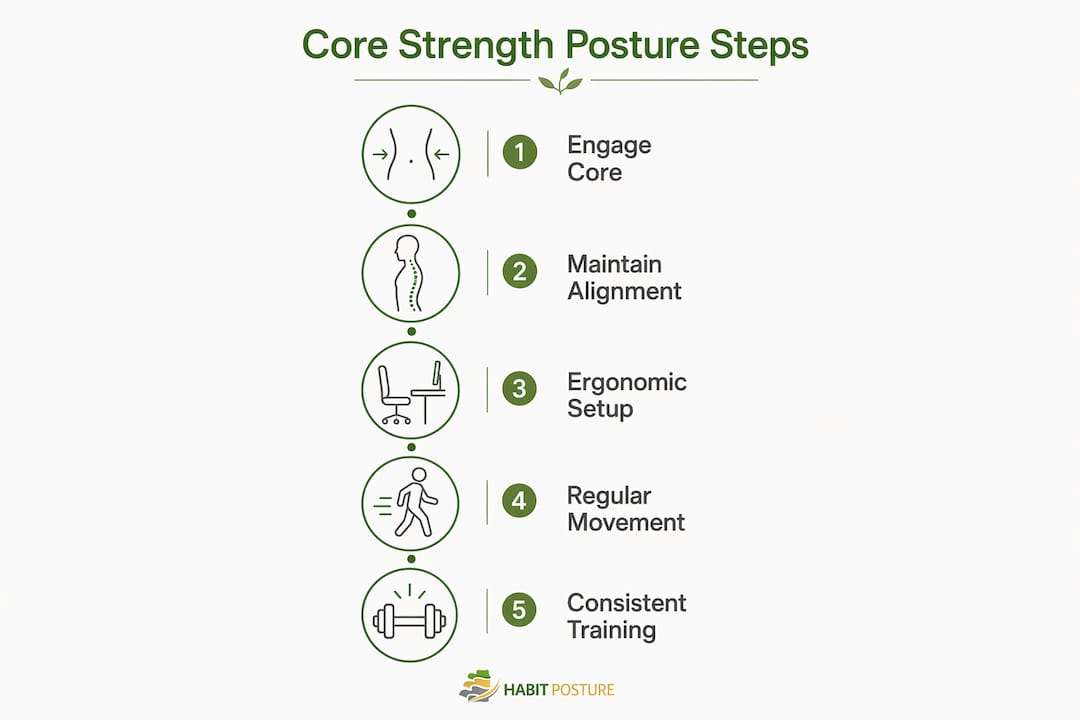
Building core strength for better desk posture requires a combination of targeted exercises, smart ergonomic setup, and consistent movement habits. No single fix covers all three.
Core stabilization exercises to start with
- Dead bug: Lie on your back, arms extended toward the ceiling, knees bent at 90 degrees. Lower one arm and the opposite leg simultaneously while keeping your lower back flat. This trains deep stabilizer coordination without loading the spine.
- Bird dog: On hands and knees, extend one arm and the opposite leg. Hold for 3 seconds, then switch. This directly targets the multifidus and erector spinae in a controlled pattern.
- Plank: Hold a forearm plank for 20–40 seconds. Focus on keeping the hips level and breathing steadily. The diaphragm and core work together here, which mirrors the demands of sustained sitting.
- Standing row: Use a resistance band anchored at chest height. Pull toward your body with elbows close to your sides. Targeting upper and mid-back muscles counteracts the forward pull of desk work.
- Diaphragmatic breathing: Sit tall and breathe deeply into your belly, not your chest. This activates the diaphragm as a core stabilizer and resets intra-abdominal pressure. Practice for 5 minutes daily.
Ergonomic setup and movement habits
Good exercises lose their effect if your workstation undoes them for 8 hours a day. Chair height directly affects core engagement and spinal alignment. Set your seat so your hips are at or slightly above knee level, which tilts the pelvis forward and activates the lumbar stabilizers naturally.
- Adjust lumbar support to fill the curve of your lower back without pushing you forward
- Position your monitor at eye level to reduce forward head load on the cervical spine
- Take regular standing breaks every 30–60 minutes to reset muscle activation patterns
- Use armrests to reduce shoulder load, but avoid resting so heavily that your core disengages
Stretching alone provides only temporary relief. Programs that combine mobility work with strengthening produce sustained posture improvements. Stretch your hip flexors and chest. Strengthen your glutes, mid-back, and deep stabilizers. Do both, consistently.
Pro Tip: Try posture improvement exercises designed specifically for desk workers. No gym required. Five to ten minutes of targeted work before or after your workday builds the neural patterns that passive sitting erodes.
Key Takeaways
Core strength is the primary driver of sustained desk posture because it provides the automatic spinal stability that conscious effort alone cannot replicate.
| Point | Details |
|---|---|
| Core is a full system | The core includes the diaphragm, pelvic floor, spinal stabilizers, and hip muscles, not just the abs. |
| Research confirms improvement | 2026 meta-analysis across 901 participants showed significant postural angle improvements from corrective core exercise. |
| Chairs suppress core function | Full back support causes deep stabilizers to stop firing automatically, requiring active retraining. |
| Effort without strength fails | Sitting up straight without core conditioning leads to compensatory muscle fatigue within minutes. |
| Combine exercise and ergonomics | Pairing core stabilization exercises with proper chair setup and movement breaks produces lasting results. |
The part most desk workers get completely wrong
I have watched people invest in standing desks, ergonomic chairs, and lumbar cushions, then wonder why their back still hurts. The gear helps. But it does not replace the muscles.
The uncomfortable truth is that building strong postural muscles early reduces the effort needed to maintain alignment. Waiting until pain forces the issue means you are already working from a deficit. The deep stabilizers have been quiet for years. Waking them back up takes longer than most people expect.
What I have found actually works is treating core training the same way you treat brushing your teeth. Short, daily, non-negotiable. Ten minutes of bird dogs, dead bugs, and diaphragmatic breathing before you open your laptop does more for your posture than an hour of yoga on the weekend. Consistency beats intensity every time.
Movement variety and neuromuscular retraining are more effective than rigid posture enforcement. Stop trying to hold a position. Start building a body that returns to alignment on its own. That is the shift that actually sticks.
— Thomas
Habitposture supports your posture from the inside out
Knowing the problem is half the battle. Habitposture gives you the other half.
Habitposture is built for people who spend 8 or more hours at a screen and need real support, not a lecture. The resources at Habitposture cover everything from posture habits at work to ergonomic setup guides grounded in the same research that backs this article. The gear is designed to work alongside your core training, not replace it. Wear it while you build the strength your posture needs. Let your body relearn what aligned feels like. Then make it a habit.
FAQ
Why does core strength affect posture so directly?
The core muscles form a cylindrical support system around the spine. When they are strong and coordinated, the spine stays aligned automatically without conscious effort.
Can I fix my desk posture without exercise?
Ergonomic adjustments help, but they do not rebuild the deep stabilizer muscles that prolonged sitting weakens. Exercise is required for lasting postural change.
How long does it take to see posture improvements from core training?
Research shows measurable improvements in postural angles within 7 weeks of consistent core stabilization training, with p ≤ 0.001 significance in muscle function outcomes.
What core exercises are best for desk workers?
The dead bug, bird dog, plank, standing row, and diaphragmatic breathing exercises target the specific muscles most affected by prolonged sitting and forward-hunched desk posture.
Does stretching fix desk posture?
Stretching provides temporary relief but does not build the strength needed for sustained alignment. Programs that combine stretching with targeted strengthening produce lasting results.