Why Chair Height Affects Posture: A Guide for Desk Workers
Chair height is the single most important ergonomic variable controlling your pelvic position, spinal alignment, and long-term comfort during extended sitting. Whether you’re grinding through a six-hour gaming session or back-to-back Zoom calls, the distance between your seat and the floor determines whether your spine stays supported or slowly collapses under its own load. Most people adjust their monitor, buy a lumbar pillow, and wonder why their back still aches. The answer is almost always the chair height they never touched.
Why chair height affects posture through pelvic and spinal alignment
Seat height is the foundational chair adjustment that determines where your feet land, how your knees angle, and whether your pelvis sits in a neutral or tilted position. Every other ergonomic adjustment you make builds on top of this one. Get it wrong, and lumbar supports, armrests, and monitor stands all lose most of their value.
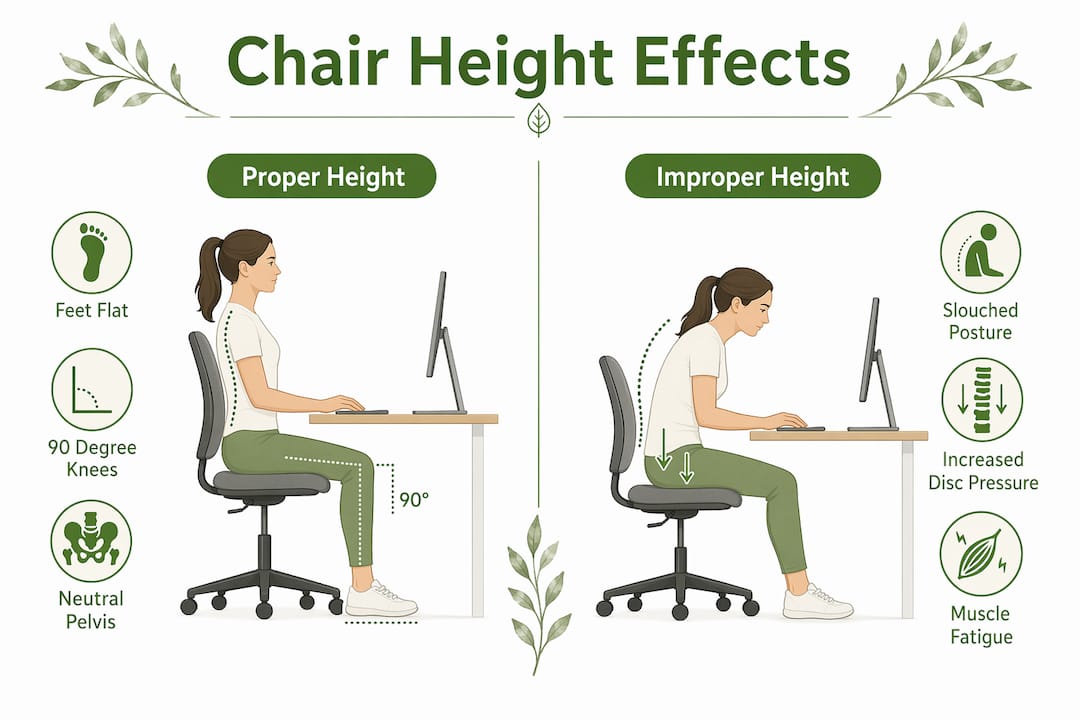
The biomechanical chain works like this. When your seat is at the correct height, your feet rest flat on the floor, your knees sit at roughly 90 degrees, and your pelvis tilts slightly forward into a neutral position. That neutral pelvic tilt preserves your lumbar lordosis, the natural inward curve of your lower spine. Lumbar lordosis diminishes with unsupported sitting, and once that curve flattens, the entire spine above it compensates by rounding forward.
A seat set too low pushes your knees above your hips. This forces a posterior pelvic tilt, which collapses the lumbar curve and loads the lower discs unevenly. A seat set too high leaves your feet dangling or forces you onto your toes, increasing pressure under your thighs and restricting blood flow. Both scenarios produce the same result: your body compensates by slumping, and your muscles work overtime to hold you upright.
- Correct height: Feet flat, knees at ~90 degrees, pelvis neutral, lumbar curve intact
- Too low: Knees above hips, posterior pelvic tilt, lumbar curve collapses
- Too high: Feet unsupported, thigh pressure increases, circulation restricted
- Both errors: Lead to forward head posture and upper back rounding over time
Pro Tip: Sit down in your chair wearing the shoes you normally work in, then check whether your thighs are parallel to the floor. If they slope downward toward your knees, the seat is too high. If they slope upward, it’s too low.
How improper chair height increases disc pressure and muscle fatigue
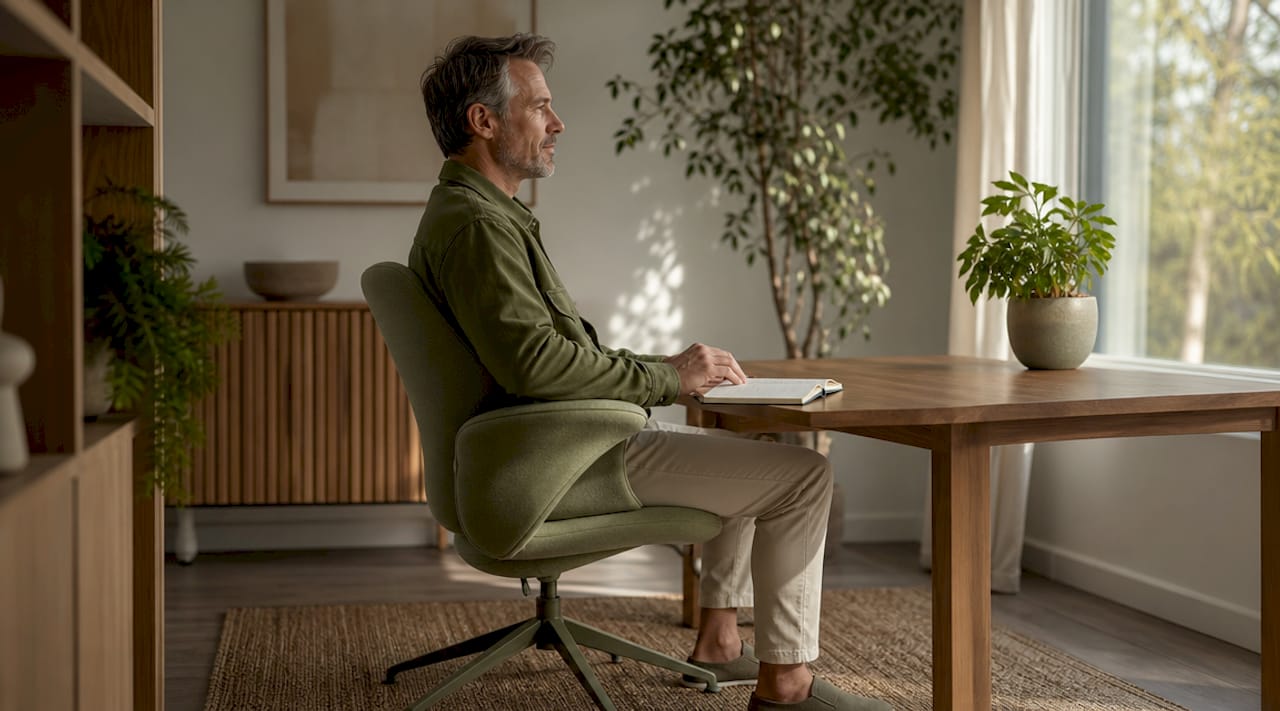
The spine is not just a structural column. It’s a pressure-bearing system, and sitting loads it differently than standing does. Upright sitting increases disc pressure 30 to 45 percent over standing. That number alone should change how you think about your chair setup. Sitting is not a rest position for your spine.
When chair height forces a slumped posture, that disc pressure climbs even higher. The lumbar discs absorb compressive and shear forces simultaneously when the spine rounds forward, accelerating wear over months and years of daily use. For remote workers logging eight-plus hours a day and gamers who routinely sit for four to six hours straight, this is not a theoretical risk.
“Slumped sitting increases intradiscal pressure beyond what upright sitting produces, raising the risk of disc degeneration over time.”
The muscular side of this equation is equally important. Poor chair height forces your erector spinae, hip flexors, and neck extensors into sustained low-level contractions to keep you from fully collapsing. These muscles don’t fatigue dramatically in one hour. They fatigue gradually, and by 3 PM your neck aches and your shoulders have crept toward your ears without you noticing.
| Sitting position | Disc pressure relative to standing | Muscle fatigue risk |
|---|---|---|
| Standing | Baseline | Low |
| Upright sitting, correct height | 30–45% higher | Moderate |
| Slumped sitting, poor chair height | Significantly higher | High |
| Reclined 100–110 degrees | Lower than upright sitting | Low to moderate |
A slight recline of 100 to 110 degrees reduces lumbar disc pressure more than sitting fully upright. This works because reclining relaxes the hip flexors, reduces posterior pelvic tilt, and distributes load across the backrest. Pairing the correct seat height with a slight recline is one of the most effective combinations for long sessions.
How footwear and seat depth interact with chair height
Chair height does not exist in isolation. Two variables that most people overlook are footwear and seat depth, and both directly affect whether your chair height setting actually delivers the posture benefits you expect.
Footwear matters more than most people realize. Footwear height changes of 2.5 cm or more require a corresponding chair height or footrest adjustment to maintain proper pelvic tilt. If you set your chair height while wearing thick-soled sneakers and then switch to socks or flat shoes, your effective seat height increases relative to the floor. Your feet no longer rest flat, your knees drop, and your pelvis tilts posteriorly. The fix is simple: either adjust your chair height when you change footwear, or use a footrest to compensate.
Seat depth creates a separate but related problem. Incorrect seat depth causes thigh pressure, circulation problems, and postural compensation that undermine even a perfectly set chair height. If the seat is too deep, you can’t sit fully back without the front edge cutting into the back of your knees. So you slide forward, lose contact with the lumbar support, and your pelvis tilts. If the seat is too shallow, your thighs lack support and you shift your weight in ways that create pressure points.
Here’s the correct sequence for coordinating these adjustments:
- Set chair height first, with your normal footwear on, until feet are flat and knees are at 90 degrees.
- Adjust seat depth so there’s a two to three finger gap between the front edge of the seat and the back of your knees.
- Sit fully back into the chair so your lower back contacts the lumbar support.
- If your feet no longer reach the floor after sitting back, add a footrest rather than raising the chair.
- Reassess when you change footwear, especially if the sole height difference is 2.5 cm or more.
Pro Tip: If you work from home and alternate between shoes and socks throughout the day, keep a footrest under your desk. It’s faster than re-adjusting your chair every time and keeps your pelvic position consistent.
What is the optimal chair height for remote workers and gamers?
The correct seat height is measured from the floor to the back of your knee while standing. This measurement, called popliteal height, gives you the starting point for your chair adjustment. Most adults fall between 16 and 21 inches, but the exact number depends on your leg length, not your overall height.
Sitting fully back into the chair is the step most people skip. You can nail the height measurement and still lose all the lumbar support benefits by perching on the front half of the seat. Sitting back means your lower back contacts the lumbar support, your pelvis stays neutral, and your spine gets the reinforcement it needs for hours of sustained sitting.
For gamers specifically, monitor distance and controller position often pull people forward in their seat. If your setup requires you to lean toward the screen, the problem is monitor placement, not your posture. Move the monitor closer rather than leaning into it. The same applies to remote workers who lean toward their laptop. An external monitor or laptop stand removes the temptation to hunch forward.
- Measure popliteal height and set chair to match, wearing your usual footwear
- Confirm feet are flat on the floor and thighs are roughly parallel to the ground
- Sit fully back so lumbar support contacts your lower back
- Use a footrest if feet don’t reach the floor after sitting back
- Set a slight recline of 100 to 110 degrees for long sessions to reduce disc pressure
- Take a standing or walking break every 45 to 60 minutes to reset muscle tension
- Reassess your setup when you change footwear or switch between desk and couch setups
Students seated without lower back support showed higher distraction and discomfort during extended sitting tasks. For gamers and remote workers, this translates directly to performance. Poor chair height doesn’t just hurt your back. It affects your focus and reaction time over a long session.
Key takeaways
Chair height controls pelvic tilt, which determines lumbar curve, disc pressure, and muscle fatigue during every hour you spend sitting.
| Point | Details |
|---|---|
| Chair height sets the foundation | Feet flat and knees at 90 degrees keeps the pelvis neutral and lumbar curve intact. |
| Slumping increases disc load | Upright sitting raises disc pressure 30–45% over standing; slumped posture pushes it higher still. |
| Footwear changes require re-adjustment | A 2.5 cm sole height difference disrupts pelvic tilt and requires chair or footrest correction. |
| Seat depth works with chair height | Sitting fully back into the correct depth seat activates lumbar support and prevents forward sliding. |
| Slight recline reduces pressure | A 100 to 110 degree backrest angle lowers disc pressure more than sitting fully upright. |
The chair height mistake I see constantly
After years of paying attention to how people actually sit, the most common mistake isn’t sitting too high or too low. It’s setting the chair height correctly and then immediately abandoning it by sliding forward to reach a keyboard or screen. You get the measurement right, sit back for thirty seconds, and then lean forward because the monitor is too far away or the desk is too high. The chair height becomes irrelevant the moment you leave the lumbar support behind.
The second mistake is treating chair height as a one-time setup task. Your footwear changes. Your desk setup changes. You move from a home office to a kitchen table. Each change shifts the effective height relationship between your body and the seat. Micro-adjustments throughout the day are not obsessive. They’re the difference between a productive afternoon and a stiff neck by dinner.
What I’ve found genuinely useful is pairing correct chair height with a slight recline and a footrest. Most people resist the footrest because it feels like an admission that the chair doesn’t fit. It’s actually the opposite. A footrest gives you the flexibility to keep your seat at the right height for your desk without sacrificing foot support. It’s one of the cheapest ergonomic upgrades available, and it solves the footwear problem automatically.
The neck and shoulder discomfort that builds up during long sessions almost always traces back to the lower body setup. Fix the chair height, sit fully back, and the upper body tends to follow. It’s not magic. It’s just biomechanics working the way it’s supposed to.
— Thomas
Build better sitting habits with Habitposture
If you’ve been adjusting your chair height and still feel the tension creeping in by mid-afternoon, the chair itself might be the limiting factor.
Habitposture designs chairs built for people who actually sit for a living. The ergonomic gaming chair with footrest includes height-adjustable settings and a built-in footrest, so you can dial in the exact pelvic position your body needs without buying extra accessories. For desk workers, the high back office chair with lumbar support pairs precise height adjustment with targeted lower back support. Explore the full range at Habitposture and find the setup that keeps you comfortable through every hour of your session.
FAQ
Why does chair height affect posture so directly?
Chair height controls foot placement and knee angle, which determines pelvic tilt. Pelvic tilt sets the lumbar curve, and the lumbar curve dictates alignment for the entire spine above it.
What is the correct chair height for back support?
Set your chair so your feet rest flat on the floor and your knees sit at approximately 90 degrees. This positions the pelvis neutrally and preserves the lumbar curve that protects your lower back.
Does chair height affect back pain during long sitting sessions?
Upright sitting already increases disc pressure 30 to 45 percent over standing. A chair height that forces slumping pushes that pressure higher, increasing the risk of disc stress and lower back pain over time.
How does footwear affect chair height settings?
A footwear sole height difference of 2.5 cm or more shifts your effective seat height relative to the floor. Switching from thick-soled shoes to socks without adjusting your chair can cause posterior pelvic tilt and lumbar flattening.
Should I use a footrest if my feet don’t reach the floor?
Yes. If sitting fully back in your chair leaves your feet unsupported, a footrest maintains foot contact and keeps your pelvic position neutral without requiring you to raise the chair to a height that creates thigh pressure.