The Role of Footrest Posture for Desk Workers and Gamers
The role of footrest posture is to provide stable support for your feet, ensuring proper alignment of your hips, pelvis, and spine while promoting circulation and reducing fatigue during extended sitting. Desk workers spend about 75% of work hours seated, a pattern that puts the lower back, pelvis, and legs under constant strain. OSHA guidelines advise that feet should be flat on the floor or supported by a footrest, with knees at roughly the same height as the hips. When your feet dangle or rest at an awkward angle, the entire chain from your ankles to your lumbar spine pays the price. A footrest is not a luxury add-on. For many desk workers and gamers, it is the foundation of a functional ergonomic setup.
What is the role of footrest posture in spinal alignment?
Proper footrest posture keeps your pelvis neutral, and a neutral pelvis is the starting point for a healthy spine. Unsupported feet cause the pelvis to tilt and the lower spine’s natural curve to flatten, which increases lumbar strain over time. A footrest acts as a foundation that stabilizes the pelvis, allowing lumbar supports to do their job effectively. Without that foundation, even an expensive ergonomic chair cannot fully protect your lower back.
The relationship between your foot position and your hip, knee, and spine angles is direct and measurable. When your feet rest flat on a stable surface, your knees bend at roughly 90 degrees. That angle keeps your hip flexors relaxed and your weight distributed evenly across the seat. When your feet hang unsupported, your hip flexors tighten to hold the leg weight, which pulls the pelvis forward and compresses the lumbar discs.
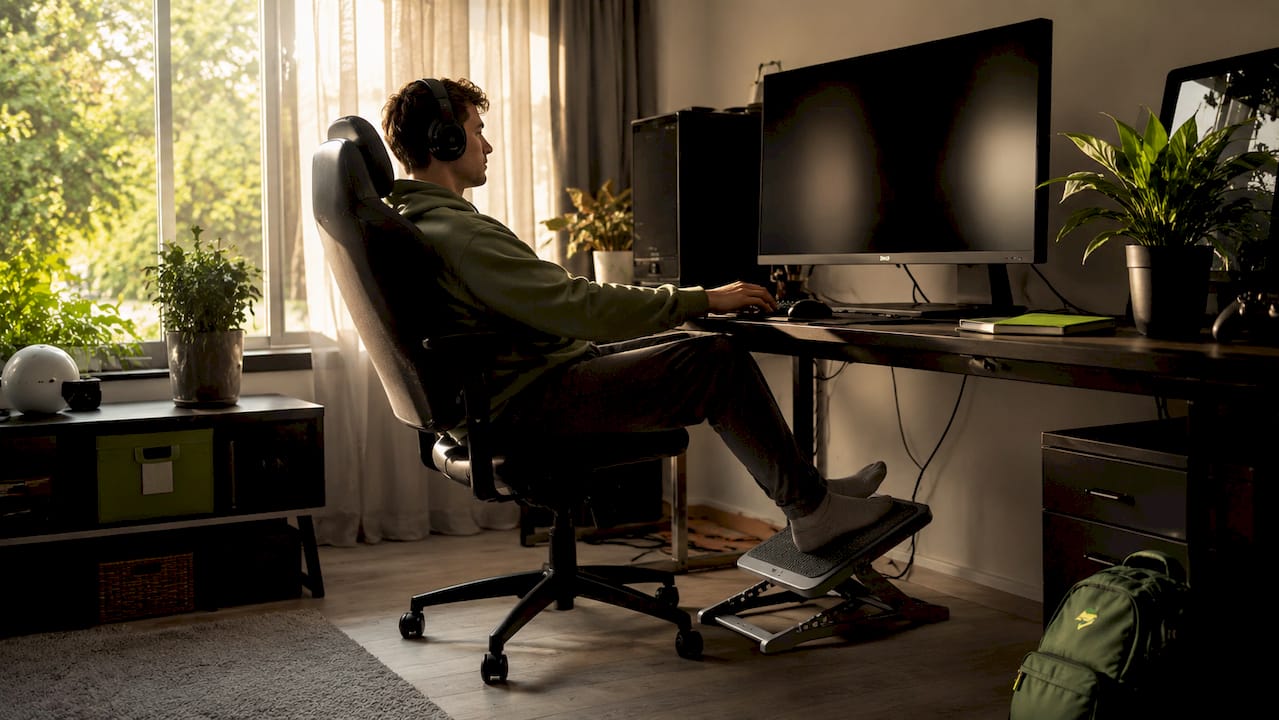
Your lumbar adjustment settings on your chair only work correctly when your pelvis is in a neutral position. A footrest makes that neutral position achievable and sustainable for hours at a time. Think of it as the ground floor of a building. Everything above it depends on its stability.
Key biomechanical effects of correct footrest posture include:
- Neutral pelvic tilt: Stable foot support prevents the pelvis from rotating forward or backward, maintaining the lumbar curve.
- Reduced disc compression: A neutral spine distributes load evenly across intervertebral discs rather than concentrating pressure at L4-L5.
- Relaxed hip flexors: Feet supported at the right height allow hip flexors to rest rather than contract continuously.
- Improved lumbar support engagement: Chair lumbar supports function as designed only when the pelvis is correctly positioned beneath them.
- Reduced neck and shoulder tension: Spinal alignment cascades upward, so a stable base reduces compensatory tension in the upper body.
How do you set the correct footrest height and tilt?
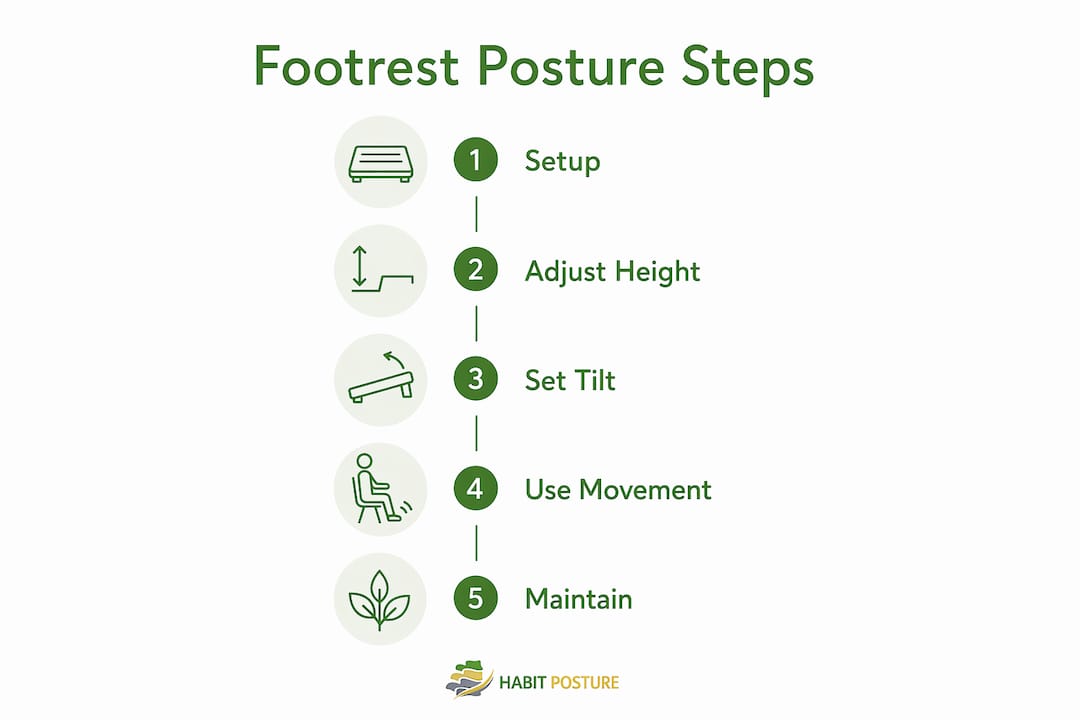
Getting the specifications right matters more than most people realize. Ergonomic guidance recommends a footrest height between 2–6 inches (5–15 cm), or approximately 10% of your body height, to maintain neutral knee-hip alignment with knees bent at 90 degrees. That range exists because body proportions vary. A footrest set too low does almost nothing. A footrest set too high compresses the back of the knee and restricts blood flow.
Follow these steps to dial in your footrest setup:
- Set your chair height first. Adjust your chair so your elbows rest comfortably at desk height with your shoulders relaxed. Do not start with the footrest.
- Check your feet. If your feet do not rest flat on the floor after setting the chair correctly, you need a footrest.
- Start low and raise gradually. Begin at the lowest footrest setting and raise it until your knees reach approximately 90 degrees and your thighs are roughly parallel to the floor.
- Adjust the tilt angle. A tilt angle of 15–45 degrees promotes ankle movement and activates the calf muscle pump, which is critical for circulation.
- Test for pressure points. Sit for five minutes and check whether you feel pressure behind the knees or on the sitting bones. Either signals the footrest is too high.
- Confirm lumbar contact. Once the footrest is set, lean back slightly and verify that your lumbar support makes full contact with your lower back.
Pro Tip: Raise your footrest by half an inch at a time and sit for at least three minutes at each setting before deciding. Small changes have a larger effect on circulation and comfort than they appear.
Incorrectly adjusted footrests that are too high can compress the vessels behind the knee, causing numbness or swelling. A poorly set footrest is worse than no footrest at all. Precision here is not optional.
When do you actually need a footrest?
A footrest is not the default solution for every desk setup. DSE ergonomic assessment standards state that footrests are required only when stable seated posture cannot be achieved after correct chair and desk height adjustments. Using a footrest to compensate for a chair that is simply set too high masks the real problem rather than fixing it.
A footrest should be the last adjustment you make, not the first. Correct your chair height, then your desk height, then assess whether your feet still need support. Skipping that sequence leads to a workstation that looks ergonomic but functions poorly.
Common situations that genuinely call for a footrest include:
- Shorter stature with a fixed desk: When the desk cannot be lowered, raising the chair creates a foot gap that only a footrest can fill.
- Chair recline users: A reclined chair without footrest support forces your hip flexors to hold the weight of your legs, causing tightness and fatigue. A footrest transforms recline from a strain position into a recovery position.
- Shared workstations: When multiple people use the same desk and chair, a portable footrest lets each person restore their individual ergonomic alignment without reconfiguring the entire setup.
- Gaming setups with fixed desk heights: Gaming desks are often fixed at standard heights that do not suit shorter players. A footrest restores neutral alignment without requiring a new desk.
Understanding how chair height affects posture is the prerequisite to knowing whether you need a footrest at all. Skipping that assessment leads to layering one fix on top of another without addressing the root cause.
What health benefits does footrest use deliver beyond comfort?
The benefits of footrest position extend well beyond feeling comfortable. The most significant physiological effect is activation of the calf muscle pump. Dynamic footrest use, shifting foot placement every 5–10 minutes, activates the calf muscles, which squeeze the deep veins of the lower leg and push blood back toward the heart. Without that movement, blood pools in the lower limbs, causing swelling, fatigue, and in extreme cases, increased clot risk.
A footrest with an adjustable tilt angle supports this dynamic use by encouraging natural ankle flexion and extension. Static foot positioning, even on a flat footrest, delivers only partial benefit. The movement is the mechanism.
| Physical outcome | How footrest use contributes |
|---|---|
| Reduced lower back fatigue | Footrest use encourages sitting back, distributing weight onto the backrest and reducing disc strain |
| Improved venous return | Ankle movement activates the calf muscle pump, reducing blood pooling in the legs |
| Reduced leg swelling | Better circulation prevents fluid accumulation in the lower limbs during prolonged sitting |
| Relaxed hip flexors | Supported feet remove the need for hip flexors to hold leg weight continuously |
| Reduced neck and shoulder tension | Neutral pelvic alignment reduces compensatory muscle activation throughout the spine |
Pro Tip: Set a timer to remind yourself to shift your foot position every 10 minutes. Alternate between placing both feet flat, crossing one ankle over the other, and pressing the ball of one foot into the footrest. Each position change activates a different set of calf muscle fibers.
Using a footrest also reduces lower back fatigue by encouraging you to sit back into your chair rather than perching forward. When your feet are supported, you naturally lean into the backrest, which distributes your body weight across a larger surface and reduces intervertebral disc strain. That single behavioral shift has a measurable effect on how your back feels at the end of an eight-hour session.
Key Takeaways
Proper footrest posture is the foundation of neutral pelvic alignment, and without it, even a well-adjusted chair and desk cannot fully protect your spine or circulation during prolonged sitting.
| Point | Details |
|---|---|
| Footrest as foundation | Stable foot support maintains neutral pelvis, allowing lumbar supports to function correctly. |
| Correct height matters | Set footrest height at 2–6 inches or 10% of body height to keep knees at 90 degrees. |
| Tilt angle drives circulation | A 15–45 degree tilt encourages ankle movement that activates the calf muscle pump. |
| Footrest is conditional | Use a footrest only after correct chair and desk adjustments fail to achieve stable posture. |
| Dynamic use beats static | Shifting foot position every 5–10 minutes reduces venous pooling and lower limb fatigue. |
The mistake I see desk workers make every single time
Most people treat a footrest like a parking spot for their feet. They set it once, plant their feet on it, and forget it exists. That approach delivers about 20% of the benefit a footrest can actually provide.
The real value of a footrest comes from using it as a movement prompt. Every time you shift your foot position, you activate your calf muscles, change the pressure distribution across your seat, and slightly alter your spinal loading. Those micro-adjustments add up over an eight-hour day. They are the difference between finishing a session feeling stiff and finishing it feeling functional.
I have also seen the opposite mistake: people who buy a footrest before they have correctly set their chair height. The footrest becomes a crutch that locks in a bad setup. The chair is too high, the footrest compensates, and the person never realizes their lumbar support is making no contact with their back because their pelvis is still tilted. Fix the chair first. Always.
The other thing worth saying plainly: no footrest replaces movement. Standing up, walking for two minutes every hour, and doing a few ankle circles at your desk all contribute more to circulation than any static footrest position. A footrest supports good posture. It does not replace an active body. Use it as part of a broader habit, not as the whole solution.
— Thomas
Habitposture and your ergonomic setup
Posture is a habit, and habits are built one adjustment at a time. Habitposture exists for people who spend 8+ hours at a screen and want practical solutions that actually fit into real life.
Whether you are dialing in your footrest height, figuring out your chair adjustment setup, or looking for gear that supports your posture while you work or game, Habitposture has the resources and products to help. No lectures. No guilt. Just straightforward support for the way you actually sit. Visit Habitposture to find ergonomic solutions built for long sessions and real bodies.
FAQ
What does a footrest actually do for posture?
A footrest provides stable support for your feet when they cannot reach the floor, maintaining neutral pelvic alignment and preserving the lumbar curve. Without foot support, the pelvis tilts and the lower spine flattens, increasing strain on the lumbar discs.
What is the correct footrest height for desk ergonomics?
The recommended footrest height is 2–6 inches (5–15 cm), or approximately 10% of your body height, with knees bent at 90 degrees and thighs roughly parallel to the floor. Start low and raise gradually until that angle is achieved.
How often should you move your feet on a footrest?
Shift your foot position every 5–10 minutes to activate the calf muscle pump and prevent venous pooling in the lower limbs. A tilted footrest with a 15–45 degree angle makes this movement easier and more natural.
Does everyone need a footrest?
No. A footrest is necessary only when stable seated posture cannot be achieved after correctly adjusting chair and desk height. Shorter users, people at fixed-height desks, and those who use chair recline are the most common cases where a footrest is genuinely needed.
Can a footrest make posture worse?
Yes, if set incorrectly. A footrest that is too high compresses the blood vessels behind the knee, restricting circulation and causing numbness or swelling. Always set your chair height first and treat the footrest as a fine-tuning tool, not a primary adjustment.