Standing Breaks and Posture: What Office Workers Need
Standing breaks are defined as intentional pauses from seated desk work that interrupt static posture and restore musculoskeletal balance. The role of standing breaks in posture health is direct: they reset muscle load, reduce spinal tissue strain, and prevent the forward collapse that builds up silently over a workday. Research from 2026 confirms that postural variation reduces musculoskeletal risk far more effectively than either sitting or standing alone. If your neck starts aching by 2 PM and your shoulders round forward without you noticing, standing breaks are not optional. They are the correction your body needs built into your day.
How do standing breaks physiologically benefit posture?
Standing breaks work because static posture is physically destructive. When you hold one position for an extended period, muscles fatigue under constant load, spinal discs lose hydration, and soft tissue undergoes a process called creep. Creep is the gradual deformation of connective tissue under sustained stress. It does not reverse itself the moment you stand up at the end of the day.
Micro-breaks as short as 30 seconds every 20 minutes prevent measurable lumbar spine tissue creep. That means you do not need a full stretch routine to protect your spine. Simply standing resets the strain cycle before damage accumulates.
Circulation is the other key mechanism. Muscle contractions from standing stimulate vasodilation and improve venous return, which maintains cerebral blood flow and brain metabolism. Better circulation also means better nutrient delivery to cartilage, which has no direct blood supply and depends entirely on movement to receive nutrients.
The benefits of standing breaks on joint health are measurable at the cellular level:
- Cartilage nutrient transport: 10-minute sit/stand intervals increased the joint health marker IGF-1 by 15.8% after 5 hours, outperforming 30-minute intervals by 5–6%.
- Muscle fatigue reduction: Frequent posture changes distribute load across different muscle groups, preventing any single group from reaching exhaustion.
- Spinal disc rehydration: Movement pumps fluid back into intervertebral discs, restoring their shock-absorbing capacity.
- Reduced forward head posture: Standing naturally encourages a more neutral cervical spine position compared to prolonged screen-forward sitting.
The takeaway is clear. Standing breaks do not just feel better. They produce measurable biological changes that protect your joints, spine, and muscles from the cumulative damage of desk work.
What is the optimal frequency and duration of standing breaks?
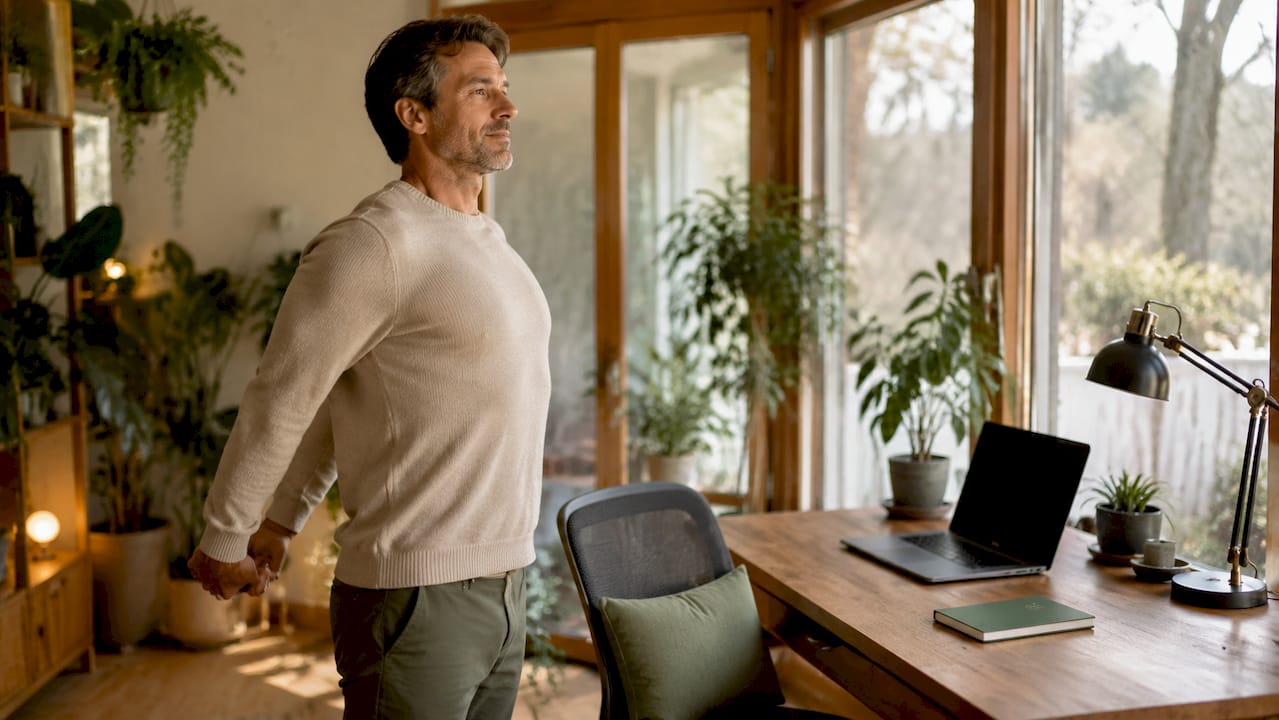
Frequency beats duration every time. Office workers who took 2-minute stretch breaks every 60 minutes reported 41% less neck and shoulder pain and 38% less lower back discomfort compared to workers who only stretched at lunch. One long break cannot undo hours of postural collapse. Short, regular interruptions are what your body actually needs.
The 60-minute mark is the practical safety floor for desk work. NIOSH and Cornell University both identify 60 minutes as the maximum before eye strain, postural collapse, and spinal tissue deformation become measurable. Waiting longer than an hour means you are already in deficit.
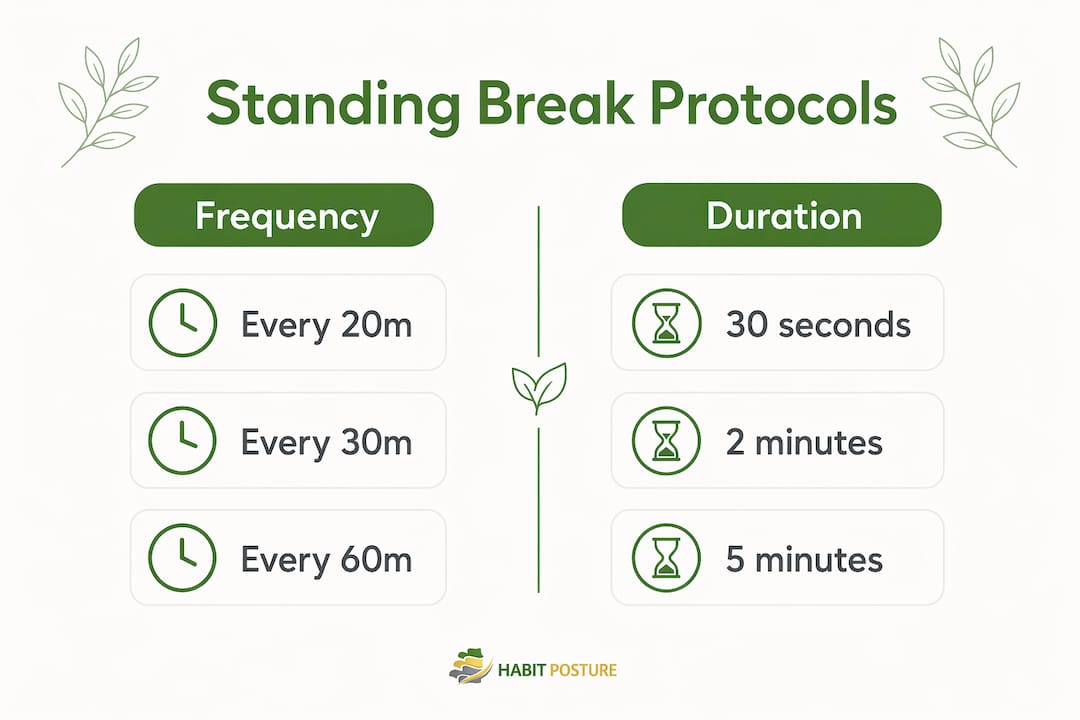
Pro Tip: Pair the 20-20-20 rule for eye strain (look at something 20 feet away for 20 seconds every 20 minutes) with a standing micro-break every 20 minutes. You protect your eyes and your spine in the same habit.
The table below compares the most researched break protocols so you can choose what fits your workflow.
| Protocol | Interval | Duration | Primary benefit |
|---|---|---|---|
| Micro-break | Every 20 min | 30 seconds | Prevents lumbar tissue creep |
| 2-minute stretch break | Every 60 min | 2 minutes | 41% less neck and shoulder pain |
| 3-minute micro-exercise | Every 60 min | 3 minutes | Reduced waist circumference, improved energy |
| 10-min sit/stand cycle | Every 10 min | Posture shift | 15.8% increase in cartilage IGF-1 |
| 20/8/2 rule | Per hour | 20 sit, 8 stand, 2 move | Balanced postural variation |
The 3-minute hourly micro-exercise break protocol, studied over 12 weeks, reduced waist circumference by 2.1 cm and fasting blood glucose by 0.31 mmol/L. Participants also reported 1.6-point energy increases and 1.3-point productivity gains. Those numbers come from a consistent habit, not a single good day.
The 20/8/2 rule is the most practical starting point for most desk workers. Spend 20 minutes sitting, 8 minutes standing, and 2 minutes moving per hour. It requires no equipment and fits into almost any work schedule.
Do standing breaks actually improve cognitive focus?
Standing breaks improve posture and they also sharpen your thinking. Sedentary behavior reduces cerebral blood flow over time, which directly affects attention, working memory, and decision-making. Breaking that sedentary pattern reverses the decline.
3-minute moderate-intensity walks every 30 minutes robustly maintain cognitive performance throughout the workday. The mechanism connects back to circulation: muscle contractions push blood back toward the brain, restoring the metabolic conditions needed for focused thinking. This is why the 2 PM slump often lifts after a short walk, not just a coffee.
The productivity case for standing breaks is strong:
- Executive function: Short activity breaks improve attention and decision-making in healthy adults, according to research published in Frontiers in Psychology.
- Energy levels: The 12-week micro-exercise study recorded a 1.6-point increase in self-reported energy among workers who took regular breaks.
- Workflow continuity: Context-aware sit-stand desk interventions show that well-timed notifications improve posture adherence without disrupting concentration, while poorly timed ones do the opposite.
- Reduced afternoon fatigue: Postural resets prevent the physical discomfort that competes with focus during the second half of the workday.
The connection between posture and workplace productivity is not abstract. A body in less pain thinks more clearly. Standing breaks deliver both benefits at once.
How to take standing breaks that actually stick
Knowing you should take breaks and actually taking them are two different problems. The gap between intention and habit is where most desk workers lose the benefit entirely.
-
Set a timer, not a reminder. A recurring alarm on your phone or a browser extension that fires every 30–60 minutes removes the decision from your hands. You do not have to remember. The timer does it for you.
-
Attach the break to an existing trigger. Stand up every time you finish a task, send an email, or join a video call. Habit stacking onto existing behaviors builds compliance faster than willpower alone.
-
Use your standing time intentionally. A 2-minute break spent scrolling your phone in a forward-head position defeats the purpose. Stand tall, roll your shoulders back, and do a few neck circles. Check out posture resets for office workers for a practical movement library.
-
Set up your workstation to support standing. A sit-stand desk removes the friction of transitioning between positions. If you do not have one, standing at a kitchen counter or a high shelf works for short breaks.
-
Check your footwear. Not all feet respond the same to prolonged standing. Biomechanical differences in foot structure affect how standing loads your knees, hips, and lower back. Supportive footwear and an anti-fatigue mat reduce discomfort and make standing breaks sustainable. Your workstation setup matters as much as the break itself.
-
Start with one break per hour. Do not overhaul your entire day at once. One consistent break every 60 minutes builds the habit. Add frequency once the first break becomes automatic.
Pro Tip: If you work from home, use your break to walk to another room. The physical change of environment reinforces the mental reset and adds light movement that a standing-in-place break does not.
Remote workers face a specific challenge: the bedroom office setup often lacks the ergonomic structure of a proper workstation, making postural collapse faster and break habits harder to form. Naming that challenge is the first step to solving it.
Key takeaways
Standing breaks are the single most accessible posture correction strategy available to desk workers, and frequency matters more than duration.
| Point | Details |
|---|---|
| Frequency over duration | Short breaks every 30–60 minutes outperform one long break at the end of the day. |
| Biological impact | 10-minute sit/stand cycles increase the joint health marker IGF-1 by 15.8% after 5 hours. |
| Cognitive benefit | Regular movement breaks maintain attention and executive function throughout the workday. |
| Practical starting point | The 20/8/2 rule (20 sit, 8 stand, 2 move per hour) fits most work schedules without equipment. |
| Setup matters | Footwear, workstation height, and sit-stand desk use all determine whether standing breaks actually help. |
What most people get wrong about standing breaks
Here is the uncomfortable truth I have seen play out repeatedly: most desk workers treat standing breaks as a reward for finishing work, not as a requirement for doing it well. They wait until the pain is bad enough to force them up. By that point, the tissue creep has already happened, the posture has already collapsed, and the afternoon focus has already dropped.
The other mistake I see constantly is treating a sit-stand desk as the solution rather than the tool. A sit-stand desk you forget to adjust is just an expensive fixed desk. The research on context-aware desk interventions makes this clear: the desk does not fix posture. The habit does.
What actually works is boring and simple. A timer. A consistent interval. A few seconds of intentional posture reset. Done every hour, every day, for weeks. The compounding effect of that consistency is what the research captures in numbers like 41% less neck pain and 15.8% better joint health. Those results do not come from one good week. They come from a habit that sticks.
The synergy between posture and overall wellness is real, but it requires you to stop waiting for the right moment and start treating movement as part of the job. Your body does not separate work time from recovery time. Every hour you spend in static posture is an hour your body is paying a cost. Standing breaks are how you pay it back before the debt gets too large.
— Thomas
Posture support built for real work days
Consistent standing breaks are the foundation of better posture. The right support gear makes that foundation stronger.
Habitposture builds posture support for people who spend 8+ hours at a screen. No bulky braces, no guilt trips. Just practical gear that works while you work. Whether you are in a corporate office or grinding from your home setup, Habitposture has tools designed to reinforce the habits you are building. Browse posture support gear at Habitposture.com and pair it with the break strategy that fits your day. Good posture is a habit. The right gear helps you build it faster.
FAQ
How often should you take standing breaks at a desk?
Stand up at least once every 60 minutes. NIOSH and Cornell identify 60 minutes as the maximum safe interval before spinal tissue deformation and postural collapse become measurable.
Do standing breaks actually improve posture long-term?
Yes. Regular standing breaks prevent lumbar tissue creep, reduce neck and shoulder pain, and improve spinal alignment over time. The effect compounds with consistent practice over weeks, not days.
What is the best standing break duration for posture benefits?
Even 30 seconds every 20 minutes prevents measurable lumbar tissue creep. For broader benefits including reduced pain and improved energy, 2–3 minutes every 60 minutes is the most research-supported interval.
Can standing breaks improve focus and productivity?
Yes. Short movement breaks maintain cerebral blood flow, which supports attention and executive function. Workers who take regular breaks report measurable gains in energy and productivity compared to those who do not.
Do remote workers need standing breaks more than office workers?
Remote workers often face worse ergonomic conditions, including makeshift setups and less structured schedules, which accelerates postural collapse. Standing breaks are at least as critical for remote workers, and in many cases more so.