Posture Fix Without a Dedicated Office Space
Posture correction without a dedicated office space is fully achievable using targeted exercises, simple environmental tweaks, and consistent daily habits. You don’t need a standing desk, an ergonomic chair, or a spare room to fix how you sit and move. The 90-90-90 ergonomic rule, which positions hips, knees, and ankles each at 90-degree angles, applies just as well to a kitchen chair as it does to a $1,000 office setup. What separates people who fix their posture from those who don’t is not equipment. It’s habit.
What does a posture fix without dedicated office space actually look like?
Effective posture correction in a non-office environment starts with your setup, not your stretching routine. Workstation positioning accounts for 80% of posture correction success versus exercise alone. That means you cannot out-train a poorly arranged workspace, no matter how many chin tucks you do.
The good news is that most home setups are fixable with items you already own. A stack of books raises your laptop screen to eye level. A rolled bath towel placed at your lower back recreates lumbar support. These are not workarounds. They are the foundation of any solid posture correction plan, office or not.

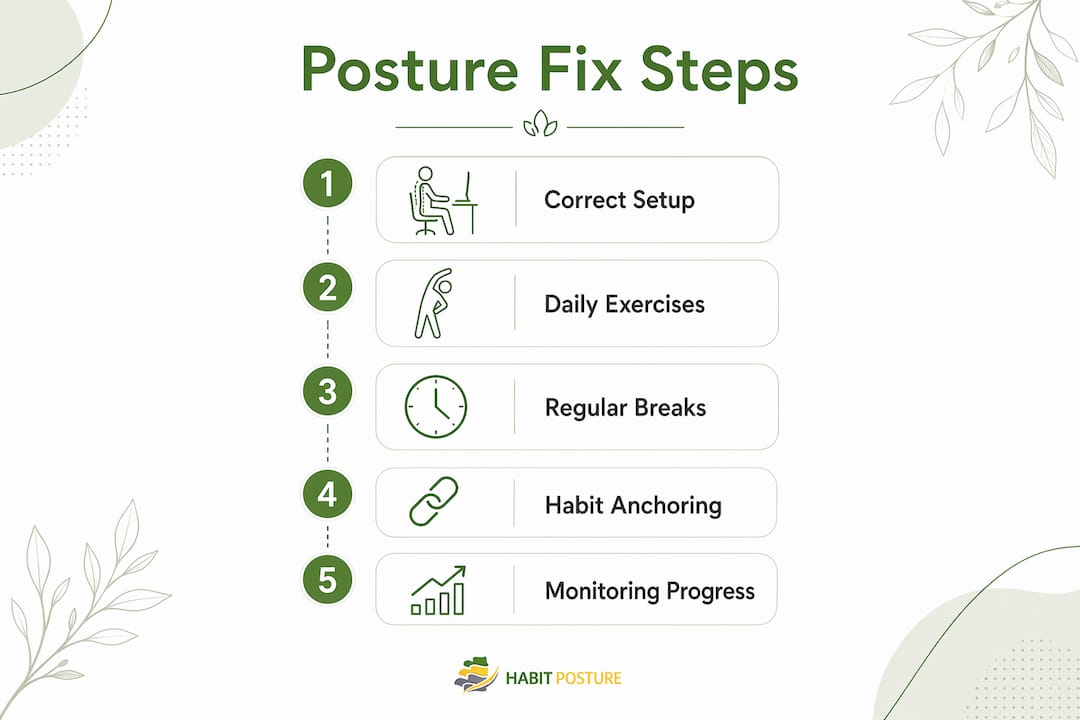
Habit formation is the second pillar. Posture is not a one-time fix. Your body defaults to whatever position it repeats most often. Building short, frequent posture resets into your existing daily routine is what creates lasting change, not a single 30-minute yoga session on Sunday.
How to adjust your home environment for better posture
Small environmental changes deliver outsized results. Raising your monitor to eye level with books and adding lumbar support with towels is dramatically more effective than expensive equipment that gets misused. The goal is neutral alignment: ears over shoulders, shoulders over hips, and hips at or slightly above knee height.
| Common Setup Problem | DIY Alternative |
|---|---|
| Screen too low (laptop on desk) | Stack books or a sturdy box under the laptop |
| No lumbar support | Roll a bath towel and place it at the small of your back |
| Keyboard too high | Sit on a firm cushion to raise your hips relative to the keyboard |
| Wrists bent upward while typing | Place a folded cloth under the keyboard’s back edge to tilt it flat |
| Feet dangling off the chair | Use a thick book or a step stool as a footrest |
Beyond screen height and lumbar support, your input device placement matters. Your keyboard and mouse should sit at a height where your elbows stay close to your body and your forearms are roughly parallel to the floor. Reaching forward or upward for your mouse pulls your shoulder blade away from your spine and starts the forward-rounding cycle.
Pro Tip: Place your monitor an arm’s length away from your face. If you have to lean forward to read text, increase the font size rather than moving closer. Leaning forward even two inches doubles the load on your neck muscles.
For people working in shared or multipurpose rooms, ergonomic workstation setup does not require a permanent arrangement. A consistent “posture kit” stored in a bag or basket, including your towel roll, book stack, and a small footrest, lets you recreate the same setup wherever you sit.
Posture exercises that require no desk or special equipment
Strengthening matters as much as stretching. Stretching lengthens tight muscles, but without strength work, those muscles return to their shortened position within hours. The most effective posture exercises without a desk target the deep spinal extensors, glutes, and scapular retractors, which are the muscles most weakened by prolonged sitting.
Targeted posture stretching programs reduce musculoskeletal pain by up to 72% within two weeks when performed twice daily for five minutes. That is a short time commitment for a significant result.
- Chin tucks. Sit or stand tall. Gently pull your chin straight back, creating a “double chin.” Hold for five seconds. Repeat 10 times. This resets forward head position.
- Thoracic extension over a chair back. Sit near the edge of a chair. Place your hands behind your head and gently extend your upper back over the top of the chair. Hold for three seconds. Repeat five times. This reverses the rounded upper back from screen time.
- Wall angels. Stand with your back flat against a wall, arms bent at 90 degrees. Slowly slide your arms upward while keeping your back and arms in contact with the wall. Repeat 10 times. This activates the scapular muscles that pull your shoulders back.
- Glute bridges. Lie on your back with knees bent and feet flat on the floor. Push through your heels to lift your hips until your body forms a straight line from knees to shoulders. Hold for two seconds. Repeat 15 times. This strengthens the glutes that support pelvic alignment.
- Dead bugs. Lie on your back with arms pointing toward the ceiling and knees bent at 90 degrees. Slowly lower your right arm and left leg toward the floor without letting your lower back arch. Return and switch sides. Repeat 10 times per side. This builds deep core stability.
Pro Tip: Habit anchoring small movements to daily triggers, like doing chin tucks every time you pour your morning coffee, increases adherence and removes the need to “remember” your routine.
Split your routine into two sessions: three exercises in the morning before you open your laptop, and two exercises after lunch. This approach anchors the habit to existing triggers and keeps each session under five minutes.
Why movement breaks matter more than perfect posture
The body is built for movement, not for holding any single position perfectly. Pure sitting or pure standing are both counterproductive. Postural variability, meaning frequent position changes, reduces muscle fatigue far more effectively than trying to maintain a rigid “correct” posture all day.
Experts recommend changing positions every 30–60 minutes with a sit-to-stand ratio of roughly 60/40 or 50/50. In a small apartment or shared space, you don’t need a standing desk to achieve this. You need a timer and a plan.
Easy movement breaks that work in any space:
- Stand and do 10 calf raises while waiting for a page to load.
- Walk to a different room for one minute between tasks.
- Perform a standing hip flexor stretch by stepping one foot forward into a lunge position and holding for 20 seconds per side.
- Do five shoulder rolls backward every time you finish a video call.
- Sit on the floor cross-legged for one work session per day to vary your hip position.
Pro Tip: Set a recurring phone alarm every 45 minutes labeled “move.” You don’t need a dedicated app. A simple alarm removes the mental effort of tracking time and makes the break automatic.
For people in shared or multipurpose rooms, movement breaks also serve a practical purpose. Stepping away from a shared table or couch gives your body a reset and signals to others that you are taking a structured break, not just wandering.
Common posture mistakes in non-office setups and how to fix them
The most common mistake remote workers make is performing generic posture workouts rather than targeting their specific postural patterns. Tailoring exercises to individual imbalances produces better results than following a one-size-fits-all routine. Before you start any program, spend two minutes observing yourself in a mirror or phone camera from the side. Note whether your head juts forward, your upper back rounds, or your lower back arches excessively. That observation tells you which muscles to prioritize.
| Common Mistake | Effective Alternative |
|---|---|
| Ignoring monitor height | Raise screen to eye level using books or a box |
| Relying only on stretching | Add strengthening exercises for spinal extensors and glutes |
| Using a posture brace all day | Wear it as a short-term reminder, then remove it and engage actively |
| Skipping movement breaks | Set a 45-minute timer and follow a short movement break list |
| Doing the same exercises daily without self-assessment | Reassess your posture monthly and adjust your routine |
Posture braces cause core muscle atrophy if used long-term. They work best as short-term reminders, not as a substitute for active muscle engagement. Wearing one for 20 minutes while you relearn a position is useful. Wearing one for eight hours while your core switches off is counterproductive.
Inconsistent routines are the second biggest pitfall. Motivation fluctuates. A routine anchored to a daily trigger, like brushing your teeth or making lunch, survives low-motivation days far better than a routine that depends on willpower alone. Consistency matters more than session length. Two minutes done daily beats 30 minutes done once a week.
Key Takeaways
A posture fix without a dedicated office space requires three things: a corrected environment, targeted daily exercises, and frequent position changes built into your existing routine.
| Point | Details |
|---|---|
| Environment comes first | Fix screen height and lumbar support before adding any exercise routine. |
| DIY adjustments work | Books, towels, and cushions replicate the function of expensive ergonomic gear. |
| Strengthen, don’t just stretch | Glute bridges, wall angels, and dead bugs build the endurance that holds posture in place. |
| Move every 45–60 minutes | Postural variability reduces muscle fatigue better than holding any single “correct” position. |
| Anchor habits to triggers | Attach posture resets to existing daily actions to maintain consistency without willpower. |
What I’ve learned from fixing posture with almost nothing
I’ve worked with people who had full ergonomic setups and terrible posture, and people sitting on kitchen stools who moved beautifully. The difference was never the equipment. It was awareness and repetition.
The insight that changed how I think about this: you cannot out-train poor setup. I used to recommend exercises first. Now I always start with the environment. Get the screen at eye level. Get the lumbar support in place. Then add movement. In that order.
The second thing I’ve learned is that people quit posture routines because they feel too big. A five-exercise program sounds manageable until day three of a busy week. Two chin tucks while the coffee brews? That sticks. Start smaller than you think you need to. Build from there.
The hardest part is not the exercises. It’s accepting that posture is a daily practice, not a problem you solve once. The people who make real progress are the ones who stop looking for the perfect routine and start repeating a simple one. Consistency is the only thing that actually works.
— Thomas
Habitposture: built for real-life posture habits
You’ve got the strategy. Now you need support that fits how you actually live and work.
Habitposture builds posture support for people who don’t have a perfect office setup, because most people don’t. Whether you’re on a couch, a kitchen chair, or a shared desk, the right gear works with your body while you focus on your day. No lectures. No bulk. Just a system that reinforces the habits you’re already building. Visit Habitposture to find posture support designed for flexible, real-world environments, and pair it with the daily habits from this guide for results that actually last.
FAQ
Can I fix my posture without any special equipment?
Yes. Raising your screen to eye level with books and adding a rolled towel for lumbar support addresses the two most common posture problems without purchasing anything new.
How long does it take to see posture improvement at home?
Targeted posture stretching programs reduce musculoskeletal pain by up to 72% within two weeks when performed twice daily for five minutes. Structural changes in muscle balance take longer, typically six to eight weeks of consistent effort.
Is sitting or standing better for posture when working from home?
Neither pure sitting nor pure standing is optimal. Experts recommend alternating between positions every 30–60 minutes at a ratio of roughly 60/40 or 50/50 to reduce fatigue and support long-term posture health.
How do I know which posture exercises I actually need?
Observe yourself from the side in a mirror or phone camera before starting any routine. Note whether your head juts forward, your upper back rounds, or your lower back arches, then choose exercises that target those specific patterns.
Are posture braces safe to use at home?
Posture braces are safe as short-term reminders but cause core muscle atrophy when worn all day over time. Use one for 20–30 minutes to reinforce correct positioning, then remove it and engage your muscles actively.