Postural Habits vs Posture Exercises: What Screen Users Need
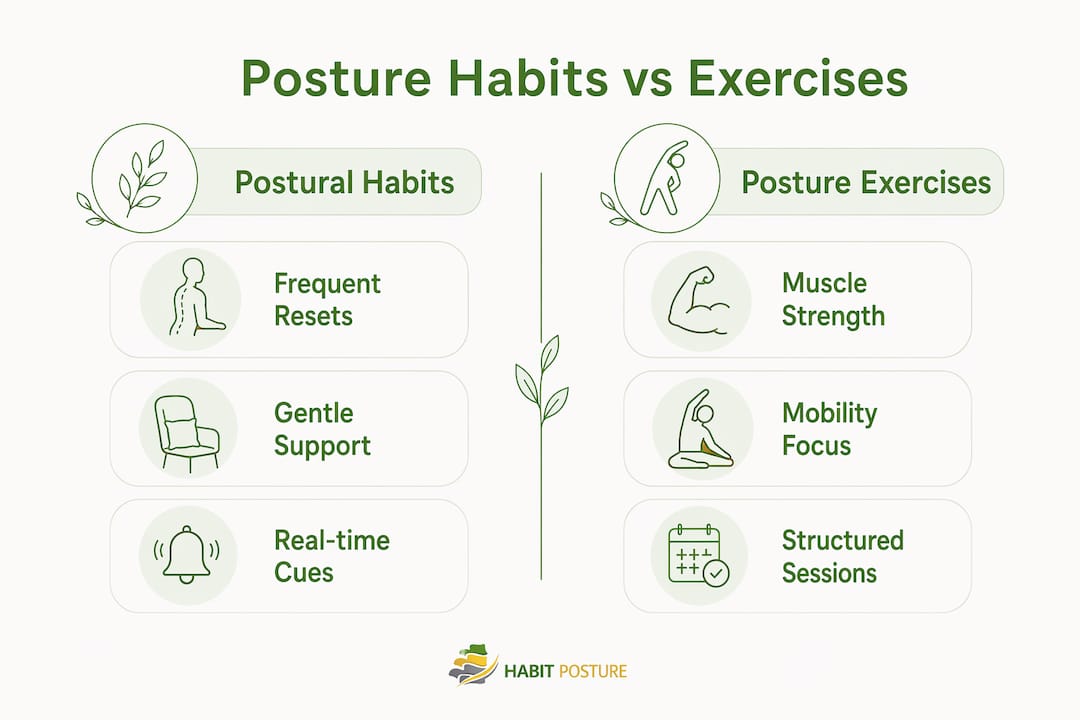
Postural habits and posture exercises are not the same thing, and confusing them is exactly why most posture improvement attempts fail. Postural habits are the unconscious, repeated body positions you default to throughout the day — the forward head creep at hour three of a Zoom marathon, the shoulder roll that happens without you noticing. Posture exercises are deliberate, structured physical activities designed to strengthen, stretch, and retrain the muscles that hold you upright. Both matter. Neither works well without the other.
Here’s the core difference at a glance:
- Postural habits shape your default alignment 24/7, driven by nervous system memory and repetition
- Posture exercises build the physical capacity — strength, mobility, motor control — to actually hold better positions
- Habits without exercise leave you with awareness but not enough muscle support to sustain good alignment
- Exercises without habit change produce gains that fade the moment you return to the same slouched routine
- The winning combination pairs consistent exercise with daily behavioral cues, movement breaks, and awareness training
Table of Contents
- Why your postural habits matter more than you think
- What posture exercises actually do — and where they fall short
- How to combine posture exercises with habit formation for lasting results
- Why movement beats holding “perfect” posture all day
- Practical tips for building better posture habits during screen time
- Habitposture makes the habit side of posture easier
- Key Takeaways
Why your postural habits matter more than you think
Posture is behavioral, not purely structural. Physical therapists consistently emphasize that your nervous system, not your skeleton, controls the positions you default to. Every hour you spend with your chin jutting forward toward a monitor reinforces that pattern at the neurological level, making it your body’s new “normal.”
For screen users spending prolonged hours a day, two habits do the most damage: forward head posture and thoracic slouching. Forward head posture places extra load on the muscles at the back of your neck, and rounded shoulders tighten the chest while weakening the upper back. Over months and years, these patterns become deeply ingrained.
Pro Tip: Set a phone alarm every 30 minutes during your workday. When it goes off, do a quick three-second posture reset: chin back, shoulder blades down and together, feet flat on the floor. That micro-check, repeated daily, starts rewiring your default alignment faster than any single workout.
Wearable posture support gear works on this same principle. Gentle, real-time physical cues remind your body to correct its position before slouching becomes habitual. You can read more about posture habits at work and how small environmental changes compound over time.
What posture exercises actually do — and where they fall short
Posture exercises build the physical foundation your habits need to stick. The research identifies deep neck flexors, scapular retractors, and thoracic extensors as priority muscle groups. Strengthening these areas improves postural alignment.

Stretching alone has little effect on long-term postural alignment. It supports strengthening work, but it cannot replace it. A doorway chest stretch feels productive; a standing row with a resistance band actually changes your posture over time.
Effective posture exercise targets for screen users:
- Deep neck flexors: chin tucks, craniocervical flexion holds
- Scapular retractors: resistance band rows, shoulder blade squeezes
- Thoracic extensors: prone T/Y raises, wall angels
- Core: modified planks, pelvic tilts
- Chest mobility (supporting role): doorway lunges, chest openers
Recommended dosing for measurable results:
| Variable | Target |
|---|---|
| Sessions per week | 2–3 |
| Session duration | 30–60 minutes |
| Program length | 4–12 weeks |
| Stretching role | Supportive, not primary |
Programs following this structure produce consistent improvements in cervical and thoracic posture angles. Sporadic five-minute stretch routines do not match what the research used to generate those results. A meta-analysis of 28 randomized controlled trials involving 901 participants confirmed that corrective exercises produce large, significant improvements in forward head angle, forward shoulder angle, and thoracic kyphosis angle. Effects on pain and function were less consistent, which is exactly why habit change and motor learning need to accompany the physical work.
How to combine posture exercises with habit formation for lasting results
The people who actually fix their posture treat it as an ongoing practice, not a six-week program. Posture improvement is a continuous commitment combining strengthening, mobility, and awareness — not a course you complete and forget.
“Posture exercise isn’t a one-time fix. It’s an ongoing practice, much like any other physical capacity. You don’t do a 12-week running program and expect to stay fast forever without continuing to run.” — Instalab posture research summary
Here’s a practical framework for combining both approaches:
- Schedule exercise like a meeting. Two to three sessions weekly, 30–60 minutes each, for at least eight weeks. Put them in your calendar.
- Pair exercises with environmental cues. Do shoulder blade squeezes every time you pour coffee. Run through chin tucks before your first morning call.
- Use wearable prompts during work hours. A posture support garment worn for two to three hours daily gives your nervous system real-time feedback between exercise sessions.
- Track one metric. Take a side-profile photo weekly. Visible progress in your head position is a powerful motivator.
- Plan for maintenance. Research shows some postural gains regress when people stop exercising entirely. Build a lighter maintenance routine after your initial program ends.
Motor-learning and awareness exercises are the bridge between gym gains and real-world posture. Even with strong muscles, your nervous system can still default to a slouch unless you actively retrain the movement pattern. Cueing ideal alignment during sitting, standing, and walking throughout the day is what makes strength gains transfer to your actual posture. Chiropractic care can also complement this process — correcting poor posture through manual work alongside exercise and habit change addresses multiple layers simultaneously.
Why movement beats holding “perfect” posture all day
No single posture is healthy when held for hours. Holding any fixed position for too long causes tissue fatigue, muscle tightness, and pain — even if that position looks textbook-perfect. The goal for screen users is not to find the one ideal posture and freeze there. It’s to move through many positions throughout the day.
Experts recommend alternating between sitting and standing every 20–60 minutes. Movement variety prevents any single muscle group from becoming overloaded and keeps your nervous system engaged. Think of it as posture training in real time, not just something that happens during your workout.
Pro Tip: Try the 20-minute rule: every 20 minutes, shift your sitting position slightly, stand up, or take a 60-second walk. You don’t need a standing desk to do this. A water bottle across the room works just as well as a $1,500 desk converter.
Strengthening muscles around the shoulders, core, and upper back reduces the fatigue that drives you into a slouch by midday. Movement breaks let those muscles recover and reset, so you’re not grinding through the last three hours of your workday on empty.
Practical tips for building better posture habits during screen time
Good posture habits don’t require a gym membership or a perfect ergonomic setup. They require consistency and a few well-placed behavioral triggers.
- Do a posture check every time you open a new tab or app. Chin back, shoulders down, feet flat. Ten seconds, every time.
- Position your monitor at eye level. A screen that sits too low pulls your head forward automatically. A stack of books works if you don’t have a monitor arm.
- Keep both feet flat on the floor when sitting. Crossing your legs rotates the pelvis and alters spinal pressure, compounding over hours.
- Use a lumbar support. A rolled towel behind your lower back keeps the natural curve of your spine without requiring constant muscular effort.
- Set a movement reminder. Use a free app like Stretchly or a simple phone timer to prompt a standing break every 30–40 minutes.
- Wear posture support gear during focused work blocks. Two to three hours of wearable support daily reinforces correct alignment without interrupting your workflow. Habitposture’s gear is built for exactly this: subtle, comfortable, and effective during long screen sessions.
- Practice transitions mindfully. How you move from sitting to standing matters. Push through your legs, keep your spine long, and avoid rounding forward as you rise.
- Stretch your chest and hip flexors daily. Screen work shortens both. A 30-second doorway stretch and a standing hip flexor stretch take less than two minutes combined.
- Strengthen your upper back three times a week. Resistance band rows and shoulder blade squeezes done consistently produce visible changes within four to eight weeks.
- Review your progress monthly. A side-profile photo taken at the same time each month shows you whether your habits are actually shifting your alignment.
Habitposture makes the habit side of posture easier
Knowing what to do and actually doing it every day are two different problems. Habitposture is built for the second one.
The wearable posture support gear from Habitposture gives your body a constant, gentle physical cue during the hours when your posture habits matter most — the long screen sessions where slouching sneaks in without you noticing. No bulky braces. No guilt. Just a wearable that works while you work, so your nervous system gets the real-time feedback it needs to build better defaults. Pair it with the strengthening routine outlined above, and you’re addressing both sides of the equation: the physical capacity and the daily habit. Visit Habitposture to find the right gear for your routine and start building posture habits that actually hold.
Key Takeaways
Postural habits and posture exercises both contribute to lasting posture improvement, but combining them with consistent movement and motor-learning cues is what produces results that hold over time.
| Point | Details |
|---|---|
| Habits shape default alignment | Unconscious body positions, reinforced daily, determine your posture more than any single workout. |
| Strengthening beats stretching | Deep neck flexors, scapular retractors, and thoracic extensors drive measurable posture improvement; stretching alone does not. |
| Exercise dosing matters | Two to three sessions weekly, 30–60 minutes each, for 4–12 weeks produces consistent posture angle improvements. |
| Movement beats static posture | Alternating positions every 20–60 minutes prevents tissue fatigue and supports better alignment throughout the day. |
| Habitposture supports the habit layer | Wearable posture gear from Habitposture provides real-time physical cues during screen sessions, reinforcing the habit changes that exercises build. |