How Posture Braces Work: Benefits and Real Limits
A posture brace is a wearable device designed to pull your shoulders back and align your spine to reduce slouching and improve postural awareness. Understanding how posture braces work is the first step toward using them effectively. These supports, also called posture correctors or scapular braces in clinical settings, apply gentle external tension to reposition your upper back and shoulders. They work best as a short-term reminder tool, not a permanent fix. People dealing with neck pain, upper back aches, or forward head posture are the most common users.
How do posture braces physically work to improve posture?
Posture braces work through two primary mechanisms: mechanical repositioning and proprioceptive feedback. Both matter, and understanding the difference helps you use a brace correctly.
Mechanical repositioning is the more obvious one. Straps or a harness pull your shoulders back and down, physically moving your shoulder blades closer together. Rigid braces add a structured panel along the spine to prevent forward rounding. Soft braces use elastic tension to guide your shoulders into a better position without locking them in place.

Proprioceptive feedback is the less obvious but arguably more important mechanism. Proprioception is your body’s ability to sense its own position. When a brace creates pressure or tension across your upper back, your nervous system registers that signal. You become more aware of when you are slouching. That awareness is what builds postural habit over time.
Here is how the two main brace types compare in practice:
- Soft elastic braces: Lightweight, worn under or over clothing, and ideal for desk workers. They guide posture through tension rather than force. Good for daily awareness training.
- Rigid or semi-rigid braces: Used more often in clinical settings for recovery from injury or surgery. They restrict movement more aggressively and are typically worn for shorter periods under professional guidance.
- Technology-enhanced braces: Some wearable devices add vibration or audio biofeedback to alert you when you slouch. These combine mechanical support with active behavioral cues.
Pro Tip: Wear your brace for 20–30 minutes during a focused work session, then remove it and try to hold the same posture on your own. That active practice after removal is where real improvement happens.
What are the proven benefits and limitations of posture braces?
The research on posture braces is real but limited. Out of 137 studies reviewed on posture brace effectiveness, only 6 met high-quality standards, with most benefits described as temporary and awareness-based. That finding does not mean braces are useless. It means your expectations need to be calibrated correctly.
What the evidence actually supports
A 2026 study found that combining scapular bracing with ergonomic workstation adjustments significantly improved both craniovertebral angle and forward shoulder angle after just 4 weeks. That result matters because it shows braces work best when paired with environmental changes, not used in isolation.
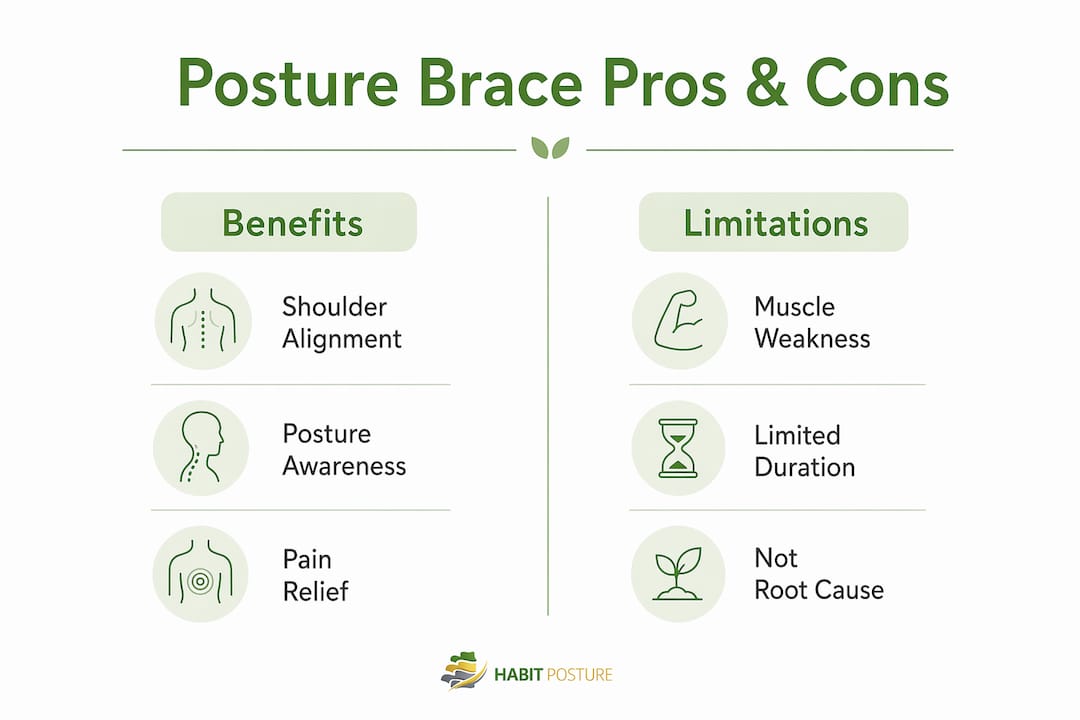
The clearest benefits documented in research include:
| Benefit | What it means in practice |
|---|---|
| Improved shoulder alignment | Shoulders pull back and down, reducing forward rounding |
| Increased postural awareness | Proprioceptive feedback reminds you to sit upright |
| Reduced neck muscle strain | Better head position decreases load on cervical muscles |
| Short-term pain relief | External support reduces fatigue during long work sessions |
Where braces fall short
Posture braces do not address root causes like core weakness, tight hip flexors, or poor standing mechanics. Posture is a full-body system involving the head, neck, back, hips, and feet. A brace only targets one part of that system.
Overuse creates a specific problem called the deconditioning trap. Prolonged brace dependence causes upper back muscles to work less, reducing their endurance and control. When you remove the brace, your posture collapses faster than before. That is the opposite of what you want.
Experts recommend limiting daily use to 30 minutes to a few hours to avoid muscular reliance. Wearing one all day, every day, trains your muscles to stop doing their job.
Pro Tip: Set a timer when you put on your brace. Thirty minutes of supported posture followed by active independent practice is more effective than eight hours of passive wearing.
What mistakes do people commonly make when using posture braces?
Most people who buy a posture brace and see no results are not using it wrong because the product failed. They are using it in a way that prevents it from working. These are the most common errors:
- Wearing it all day. This is the single biggest mistake. External tension reduces muscular engagement when the brace does the work your muscles should be doing. Limit use to focused intervals.
- Treating it as a standalone fix. A brace does not correct posture on its own. Without strengthening the upper back, rhomboids, and core, the underlying weakness remains untouched.
- Ignoring fit. A brace that is too loose provides no meaningful feedback. One that is too tight restricts breathing and circulation. Proper fit means you feel gentle resistance, not pain or pressure.
- Skipping movement breaks. Staying static in a brace for extended periods does not help. Your spine needs movement to stay healthy. Braces are not a substitute for getting up and moving.
- Using a brace for severe symptoms. Medical professionals caution against brace use when pain radiates to the legs or comes with numbness. Those symptoms need professional assessment, not a consumer wearable.
The pattern behind all these mistakes is the same. People expect a passive device to produce an active result. Posture is a skill. A brace is a training aid, not a cure.
How to build a posture plan that actually works
A posture brace works best as one component in a broader plan. Here is a practical structure that combines the brace with the elements research consistently supports.
-
Set a wear schedule. Use your brace during high-risk periods, such as long Zoom calls, gaming sessions, or focused desk work. Aim for 20–30 minute intervals with breaks in between. Short wearing periods paired with independent practice build muscular endurance over time.
-
Adjust your workstation. Your monitor should sit at eye level so your head stays neutral. Your chair should support your lumbar spine. Feet should rest flat on the floor. A 2026 study confirmed that ergonomic workstation adjustments combined with bracing produce measurably better results than either approach alone. For a full breakdown, the posture and workplace productivity guide covers workstation setup in detail.
-
Strengthen the muscles that hold you upright. The brace reminds you where your shoulders should be. Exercises build the strength to keep them there. Focus on:
- Rows and face pulls for upper back and rhomboids
- Dead bugs and planks for core stability
- Chin tucks for cervical alignment
- Chest stretches to counteract tightness from forward posture
-
Add mobility work. Tight pectorals and hip flexors pull your body out of alignment. Stretching these areas daily reduces the mechanical load that causes slouching in the first place.
-
Take movement breaks every 30–60 minutes. Standing up, walking briefly, and resetting your posture manually reinforces the habit your brace is trying to build. People who improve posture without gym access rely heavily on these micro-breaks as their primary tool.
The goal of this plan is to make the brace unnecessary over time. You are using it to teach your body a pattern, not to replace the pattern permanently.
Key takeaways
Posture braces improve alignment temporarily through mechanical repositioning and proprioceptive feedback, but lasting correction requires active muscle strengthening and ergonomic changes.
| Point | Details |
|---|---|
| Braces use two mechanisms | Mechanical repositioning and proprioceptive feedback work together to improve posture awareness. |
| Evidence is limited but real | Only 6 of 137 studies met high-quality standards; benefits are real but mostly short-term. |
| Overuse causes muscle weakness | Wearing a brace all day triggers deconditioning, making posture worse when the brace is removed. |
| Combine with ergonomics | Pairing brace use with workstation adjustments produces measurably better alignment outcomes. |
| Use it as a training tool | Short intervals of brace use followed by independent posture practice build lasting muscular endurance. |
What I have learned after years of watching people use posture braces
People come to posture braces with a lot of hope and not enough context. I get it. When your neck aches by 2 PM and your shoulders have been creeping forward for months, anything that promises relief sounds worth trying. But the gap between what braces promise and what they actually deliver is where most people get frustrated.
Here is what I have found to be true: a posture brace is one of the most effective awareness tools available, and one of the most misused products in the wellness space. The problem is not the device. The problem is that passive support feels like progress. You put it on, your shoulders go back, and you think the work is done. It is not.
The people who see real, lasting change are the ones who treat the brace like a coach, not a crutch. They wear it for a focused session, remove it, and then try to hold that same position on their own. That active effort after removal is where the neuromuscular retraining actually happens. The brace creates the reference point. Your muscles have to learn to maintain it.
My honest recommendation: if your symptoms are mild to moderate, a quality posture support paired with a consistent strengthening routine will serve you well. If you have pain that radiates, numbness, or symptoms that are getting worse, see a physical therapist or physician before reaching for any wearable. A brace is not a substitute for a proper diagnosis.
— Thomas
Habitposture gear built for real-life posture correction
Habitposture was built for people who spend 8+ hours in front of a screen and want a practical, no-guilt way to start fixing their posture. Not a bulky medical device. Not a lecture. Just wearable support that fits into your actual day.
The wearable posture support lineup from Habitposture is designed to work as a training tool, not a dependency. Wear it during your most posture-intensive hours, pair it with the ergonomic and strengthening guidance on the site, and let your body build the habit. Whether you are grinding through spreadsheets or powering through a long gaming session, Habitposture fits the way you actually live. Visit habitposture.com to find the right support for your situation and get started.
FAQ
What is a posture brace and how does it work?
A posture brace is a wearable device that uses straps or a harness to pull your shoulders back and align your spine. It works through mechanical repositioning and proprioceptive feedback, making you more aware of when you are slouching.
How long should you wear a posture brace each day?
Experts recommend limiting use to 30 minutes to a few hours per day to avoid muscle weakening. Wearing a brace all day reduces the muscular engagement needed for lasting posture improvement.
Can a posture brace permanently fix bad posture?
A posture brace cannot permanently correct posture on its own. Lasting improvement requires combining brace use with targeted muscle strengthening, mobility work, and ergonomic adjustments.
Are posture braces safe for people with back pain?
Posture braces are generally safe for mild to moderate back and neck discomfort. Medical professionals advise against using them when pain radiates to the legs or comes with numbness, as those symptoms require professional evaluation.
What exercises should I pair with a posture brace?
Rows, face pulls, and dead bugs strengthen the upper back and core muscles that hold your posture in place. Chest stretches and chin tucks address the tightness that pulls your body out of alignment in the first place.