Best Desk Accessories for Posture and Carpal Tunnel Relief
For long-hour screen workers, four posture-focused desk accessories move the needle most: a Habitposture posture corrector, a lumbar support cushion, an adjustable high-back ergonomic chair with active-seat features, and a massage gun for end-of-day recovery.
- Posture corrector: Pulls the shoulders back and cues better upper-back alignment during the hours when your body drifts forward without you noticing.
- Lumbar support: Keeps the lower spine in a neutral curve, reducing pelvic tilt and the low-back fatigue that builds through a full workday.
- High-back ergonomic chair with dynamic seat: Supports the full spine while allowing micro-movements that reduce calf swelling and perceived back pain during prolonged sitting.
- Massage gun: Targets tight traps, rhomboids, and lumbar muscles at the end of the day for short-term stiffness relief and faster recovery.
Most people notice a difference within days to a few weeks. These accessories support your body, but they don’t replace a physical therapist or physician when symptoms are serious.
Table of Contents
- What do “carpal tunnel desk accessories” actually mean here?
- What does the research say about safe use and contraindications?
- What does a practical daily desk routine look like?
- Key Takeaways
- Why Habitposture takes a habit-first approach to posture gear
- Habitposture covers all four accessory categories in one place
- Useful sources
What do “carpal tunnel desk accessories” actually mean here?
The phrase gets used loosely online. Here, it means posture-focused desk tools for people who sit 8+ hours: the gear that reduces neck, shoulder, and back strain from sustained screen work. It does not mean wrist braces, ergonomic keyboards, or wrist rests designed to address hand and wrist conditions. That’s a different product category with a different audience.
Four categories matter for long-hour desk workers:
Posture correctors and upper-back braces wrap around the shoulders and upper back to cue retraction and reduce forward rounding. A randomized crossover trial found a commercial scapular brace reduced lower trapezius activity and modestly improved rounded-shoulder posture during a 30-minute typing task. The effect is real, though short-term. Pair bracing with movement, not instead of it.
Lumbar supports and cushions fill the gap between your lower back and the chair’s backrest. Research confirms that lumbar support and seat-pan tilt promote more neutral spine and pelvic postures during prolonged sitting, though they don’t eliminate pain for every user. People who develop pain during long sits tend to benefit most from targeted lumbar intervention.
Adjustable high-back ergonomic chairs with dynamic seat pans go further than standard office chairs. A multiaxial seat-pan design increased micro-movements, mitigated calf swelling, and reduced perceived low-back pain during a two-hour typing exposure. Active sitting means using the chair’s movement, not just owning it.
Massage guns and recovery tools address the muscular stiffness that accumulates from hours of static posture. Systematic reviews confirm percussive therapy improves short-term flexibility, range of motion, and recovery outcomes tied to sedentary-work soreness.
Pro Tip: Match the category to your primary symptom. Neck and shoulder tension? Start with a posture corrector. Low-back fatigue by midday? Prioritize lumbar support and a chair with seat-pan adjustability. End-of-day muscle soreness across the upper back? A massage gun handles that better than any cushion.
What does the research say about safe use and contraindications?
Systematic reviews support short-term benefits for percussive devices, and clinical guidance from Mayo Clinic frames massage guns as useful recovery adjuncts when used properly. The key word is “adjunct.” They supplement professional care; they don’t replace it for chronic or frequent pain.
| Parameter | Recommended Range | Notes |
|---|---|---|
| Session duration | 1–2 minutes per muscle group | Longer sessions risk tissue irritation |
| Frequency | Once or twice daily | Avoid consecutive sessions on the same area |
| Pressure | Light to moderate | Let the gun’s weight do the work |
| Speed setting | Low to medium | Start low; increase only if tolerated |
Sources: PMC systematic review; Hackensack Meridian Health PT guidance
Physical therapists advise choosing a massage gun with adjustable speed settings and interchangeable heads. Stop immediately and consult a clinician if you notice bruising, worsening pain, or numbness after use.
Contraindications for massage guns:
- Recent fractures or acute injuries at the target site
- Deep vein thrombosis (DVT) or blood clotting disorders
- Open wounds, skin infections, or active inflammation
- Osteoporosis in the target area
- Pregnancy (over the abdomen or lower back)
- Implanted devices (pacemakers, metal hardware near the site)
For posture wearables, a scoping review cautions that posture-correcting garments can change posture in healthy people but currently show limited evidence for long-term pain reduction. Passive reliance on a brace without active movement may actually reduce functional mobility over time.
Pro Tip: Use your posture corrector as a training cue, not a crutch. Wear it during focused work sessions, then take it off and move. The goal is to retrain your body’s awareness, not to outsource it permanently to a garment.
What does a practical daily desk routine look like?
Accessories like the Solid Jersey Gel Mouse Pad / Wrist Rest work best when paired with a repeatable setup and scheduled breaks. The gear is the foundation; the habit is what makes it stick.
Desk setup checklist:
- Monitor top at or just below eye level, roughly arm’s length away
- Keyboard positioned so elbows stay at 90–110 degrees, wrists neutral
- Seat height adjusted so feet rest flat on the floor or a footrest
- Lumbar support placed at the natural curve of your lower back, not at the shoulder blades
- Armrests supporting the forearms without lifting the shoulders
For a deeper look at desk setup ergonomics that work across different workday lengths, Habitposture’s setup guide covers the specifics.
Break schedule:
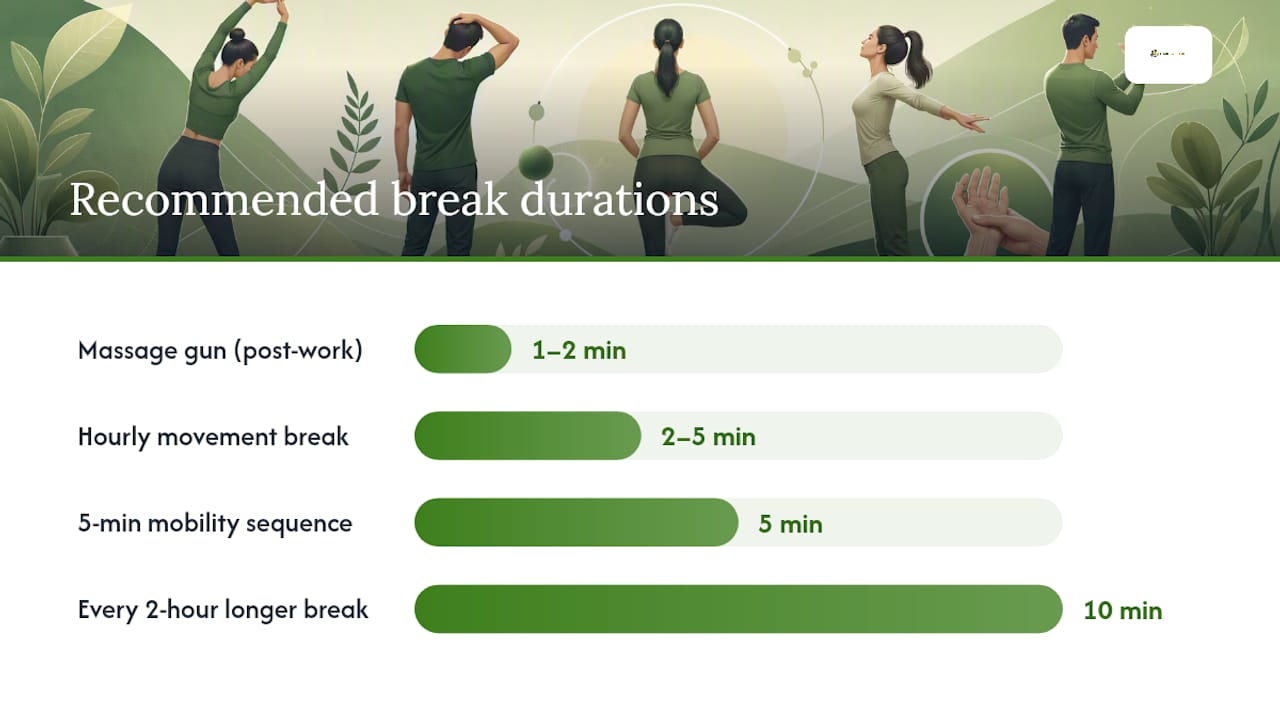
- Every 20–30 minutes: stand, shift weight, or do a brief shoulder roll.
- Every hour: take a 2–5 minute movement break. Walk to the kitchen, do a wall chest stretch, or roll your hips in your chair.
- Every 2 hours: a longer 10-minute break with light mobility work.
A quick 5-minute mobility sequence: chin tucks (10 reps), doorway chest openers (30 seconds each side), and seated hip circles (10 each direction). These three moves address the three areas that tighten fastest during screen work.
Save the massage gun for the end of the day. Using it immediately before focused strength activity can temporarily reduce muscle activation. Post-work is the right window: 1–2 minutes on the upper traps, rhomboids, and lumbar region, at low to medium intensity.
Key Takeaways
The most effective approach to posture-focused desk accessories is pairing adjustable, well-fitted gear with scheduled movement breaks and conservative recovery tool use.
| Point | Details |
|---|---|
| Prioritize adjustability | Fit and adjustability matter more than price tier when choosing any posture accessory. |
| Pair gear with microbreaks | Accessories reduce strain most when combined with movement every 20–30 minutes. |
| Use massage guns conservatively | Keep sessions to 1–2 minutes per muscle group at low to medium intensity, once or twice daily. |
| Posture wearables cue, not cure | Braces improve awareness and short-term posture metrics; active movement is still required for lasting change. |
| Habitposture starter option | Habitposture offers posture correctors, lumbar supports, high-back chairs, and massage guns as a practical one-stop starting point. |
Why Habitposture takes a habit-first approach to posture gear
The conventional posture advice gets one thing wrong: it treats posture as a discipline problem. You’re not forgetting to sit up straight because you’re lazy. You’re forgetting because you’re focused, and your body defaults to whatever position costs the least effort in the moment.
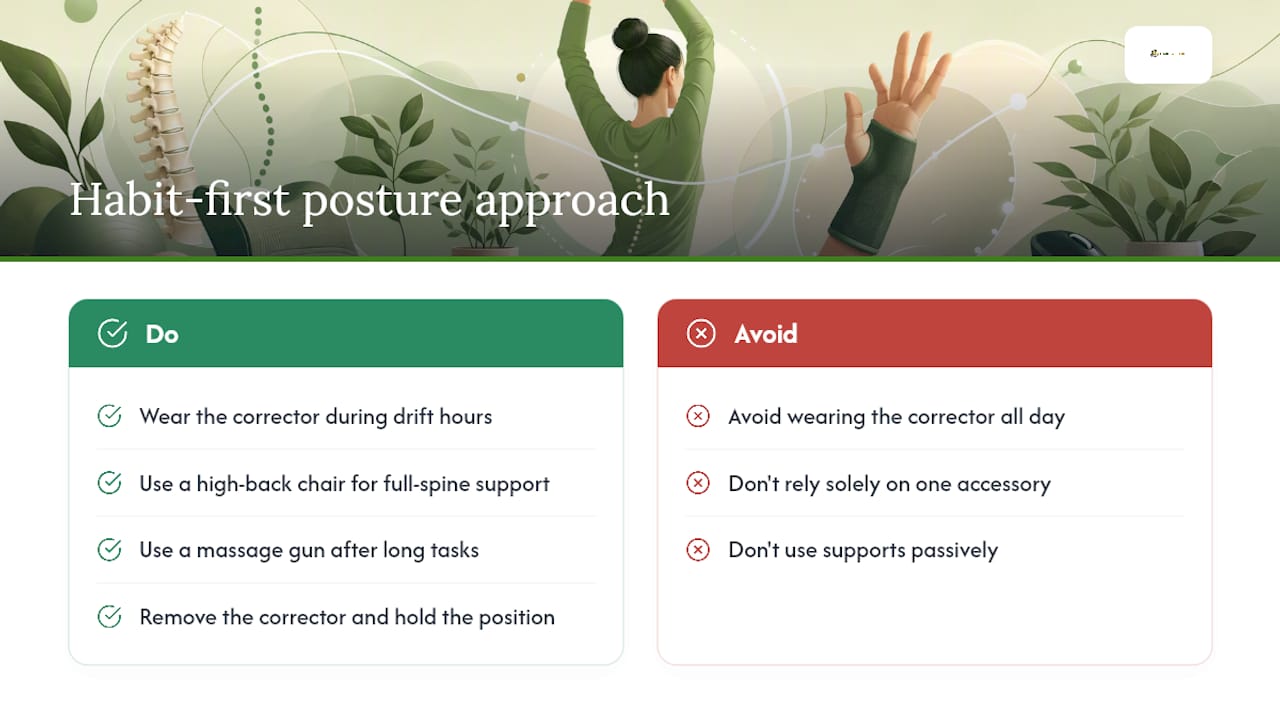
Habitposture builds gear for that reality. The posture corrector isn’t meant to be worn all day. It’s meant to be worn during the hours when your body drifts, so it learns what aligned feels like. The high-back chair supports the full spine without demanding perfect posture from you every second. The massage gun handles the stiffness that accumulates when you’ve been locked in a task for three hours straight.
What most articles miss is that passive reliance on any single accessory, whether a brace or a cushion, can actually reduce your body’s own postural engagement over time. The research on posture-correcting garments flags this directly. The right approach uses accessories as training tools, not permanent supports. Wear the corrector, feel the position, then take it off and hold it yourself. That’s the loop that builds the habit.
For desk workers who want to understand why posture gear matters beyond the marketing, the evidence points to one consistent finding: small, consistent interventions compound. A well-fitted lumbar support used daily beats an expensive chair used passively.
Habitposture covers all four accessory categories in one place
Eight hours at a screen is a long time to spend in a body that’s fighting its own setup. Habitposture’s catalog maps directly to the four accessory types this article recommends: posture correctors for upper-back alignment, lumbar supports for neutral spine positioning, high-back ergonomic chairs with adjustable features, and massage guns for targeted end-of-day recovery.
Every product ships with a clear return policy so you can test it across a real workweek before committing. No guesswork about whether it fits your chair or your frame. If it doesn’t work for your setup, you’re not stuck with it.
Browse the full range and find your starting point at Habitposture. Free shipping details and return terms are listed at checkout.
Useful sources
- The Effects of Massage Guns on Performance and Recovery: A Systematic Review - PubMed
- The Effects of Massage Guns on Performance and Recovery: A Systematic Review - PMC
- How a Massage Gun Works and Its Potential Benefits - Mayo Clinic
- Effect of office chair design features on lumbar spine posture, muscle activity and perceived pain during prolonged sitting - PubMed
- A multiaxial seat pan design compared to a standard office chair - ScienceDirect
- Scoping review: evidence for posture-correcting shirts - De Gruyter/Brill
- Are massage guns good for you? A PT explains - Hackensack Meridian Health
- Short-term effects of scapular bracing on posture and muscle activity during typing - MDPI