Best Upper Back Braces for Remote Workers: 2026 Picks
The Habit Posture Adjustable Posture Corrector is the best single pick for upper back support while working from home. It’s adjustable, breathable, and built for all-day screen use without the bulk of a medical-grade brace.
Quick picks by use case:
- Best overall: Habit Posture Adjustable Posture Corrector — adjustable fit, breathable materials, wearable under clothing during long desk sessions
- Best discreet trainer: Wearable posture trainer (tech-reminder category) — vibration cues via app, no visible straps
- Best fuller upper-back coverage: Full upper-back panel brace (category) — broader mid- and upper-back structure for heavier rounding
- Best lumbar add-on: Lumbar support / lower-back belt (category) — pairs with an upper-back corrector for combined spinal support
Who should buy the Habit Posture corrector: Remote workers who sit for many hours a day, want a posture reminder they can slip on and forget about, and need something discreet enough for video calls. Size up if you’re between sizes. Wear time should build gradually. If you have chronic or severe back pain, see a clinician before relying on any consumer brace.
Table of Contents
- How the best upper back braces for work from home compare
- How this shortlist was built
- Detailed picks: who each option fits and how to wear it
- How to choose the right upper-back brace for working from home
- Wearing your brace safely: schedules, limits, and when to stop
- Other options worth knowing about
- Key Takeaways
- The honest case for habit-based posture support
- The Habitposture adjustable corrector is ready when you are
- Sources and further reading
How the best upper back braces for work from home compare
The table below covers the shortlist across the dimensions that matter most for desk work. For remote workers, comfort and discreteness are the two factors worth prioritizing above everything else. A brace you stop wearing after three days helps nobody.
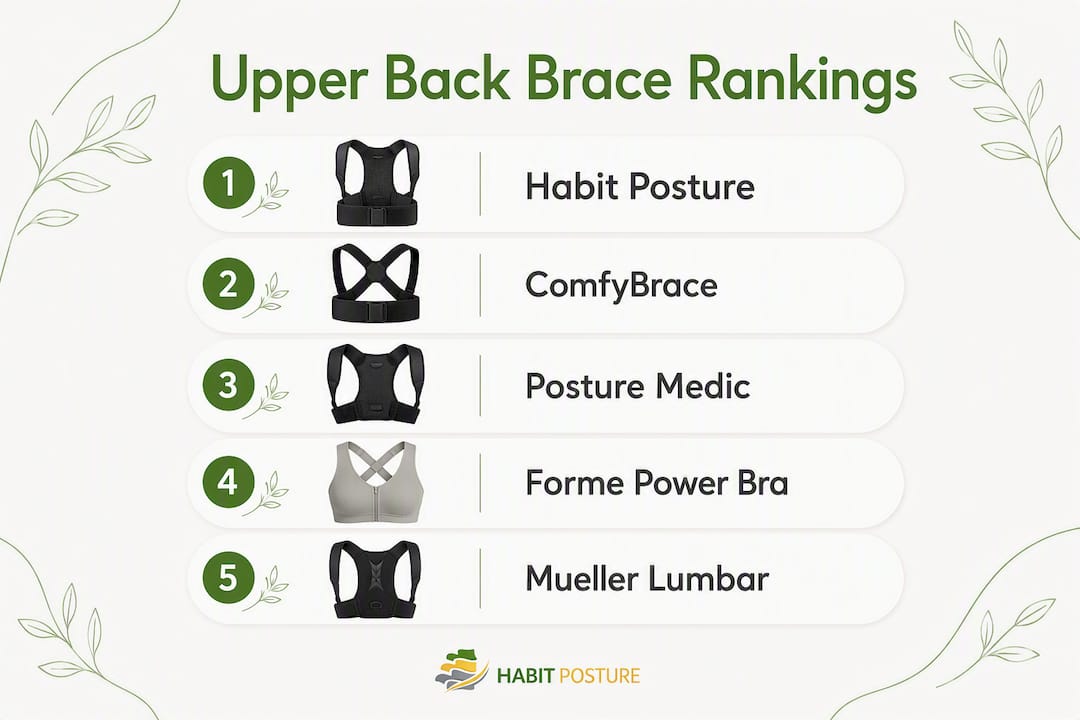
| Product | Best For | Support Style | Discreteness | Wear-Time Guidance | Price Range |
|---|---|---|---|---|---|
| Habit Posture Adjustable Posture Corrector | All-day screen work, remote workers | Soft adjustable brace | High — wearable under clothing | Build wear time gradually; start with short periods per session | Mid-range |
| Soft shoulder-strap posture brace | Beginners, mild rounding | Lightweight strap | High | Short sessions, habit training | Budget–mid |
| Full upper-back panel brace | Heavier rounding, more structure needed | Panel / semi-rigid | Lower — visible under thin shirts | Moderate sessions | Mid–high |
| Wearable posture trainer (tech-reminder) | Discreet reminders, app users | Haptic vibration device | Very high | App-guided sessions | Mid–high |
| Lumbar support / lower-back belt | Lower-back pain, combined support | Belt / lumbar wrap | Moderate | As needed while seated | Budget–mid |
| ComfyBrace Adjustable Posture Corrector | Mid and upper spine support | Soft adjustable brace | High — fits under clothes | Start 5–10 min, build to 1–2 hrs | Budget–mid |
| Upright Go S / Upright wearable trainer | App-guided posture training | Adhesive haptic device | Very high | App-guided progressive sessions | Mid–high |
| Posture Medic | Active posture training with resistance | Resistance strap brace | Moderate | Short exercise sessions | Budget–mid |
| Forme Power Bra | Women seeking discreet posture support | Integrated bra/brace | Very high | All-day wear potential | High |
| Upright Go S Lite Posture Corrector Trainer | Budget-friendly tech reminders | Adhesive haptic device | Very high | App-guided sessions | Budget–mid |
| Mueller Lumbar Support Back Brace | Lower-back support, heavy sitting | Lumbar belt | Moderate | Extended seated sessions | Budget |
| BAXMAX Back Support | General back support, office use | Panel support belt | Moderate | Daytime wear | Budget–mid |
| BraceAbility Work Back Brace for Heavy Lifting | Physical labor + desk hybrid roles | Semi-rigid panel | Low | Task-specific wear | Mid |
| SEROLA Sacroiliac Belt | Sacroiliac joint pain, lower-back instability | Targeted SI belt | High under clothing | As directed by clinician | Mid |
| Aspen Evergreen 637 LSO Back Brace | Post-injury or clinical lower-back support | Rigid LSO brace | Low | Clinician-directed only | High |
Where to buy: The Habit Posture corrector is available directly on the Habitposture website. The other categories and named products are typically available through major online retailers or direct-to-consumer brand sites.
How this shortlist was built
Every pick on this list was evaluated against the same set of criteria, drawing on published testing protocols, orthopedic guidance, and real-user wear feedback. The selection approach prioritized real-world wearability over lab specs.
Selection criteria used:
- Comfort and breathability: Materials must stay wearable through a full work session without skin irritation or excessive heat buildup
- Adjustability and size range: Straps, panels, or clips must accommodate a realistic range of body sizes without requiring professional fitting
- Discreteness: Can it be worn under a regular shirt during a video call without being visible?
- Support style match: Does the device match the user’s actual need (posture habit training vs. structural upper-back support vs. lumbar support)?
- Wear-time guidance: Does the product provide clear guidance on how long to wear it per session?
- Return and warranty policy: Is there a reasonable return window or warranty if the fit doesn’t work?
Testing methodology followed the standard used by major health publishers: each device type was assessed for at least one hour of regular desk tasks, scoring comfort, fit, and whether it encouraged posture without feeling overly restrictive. Clinical guidance from spine-health resources informed the safety limits and brace-type distinctions throughout.
Detailed picks: who each option fits and how to wear it
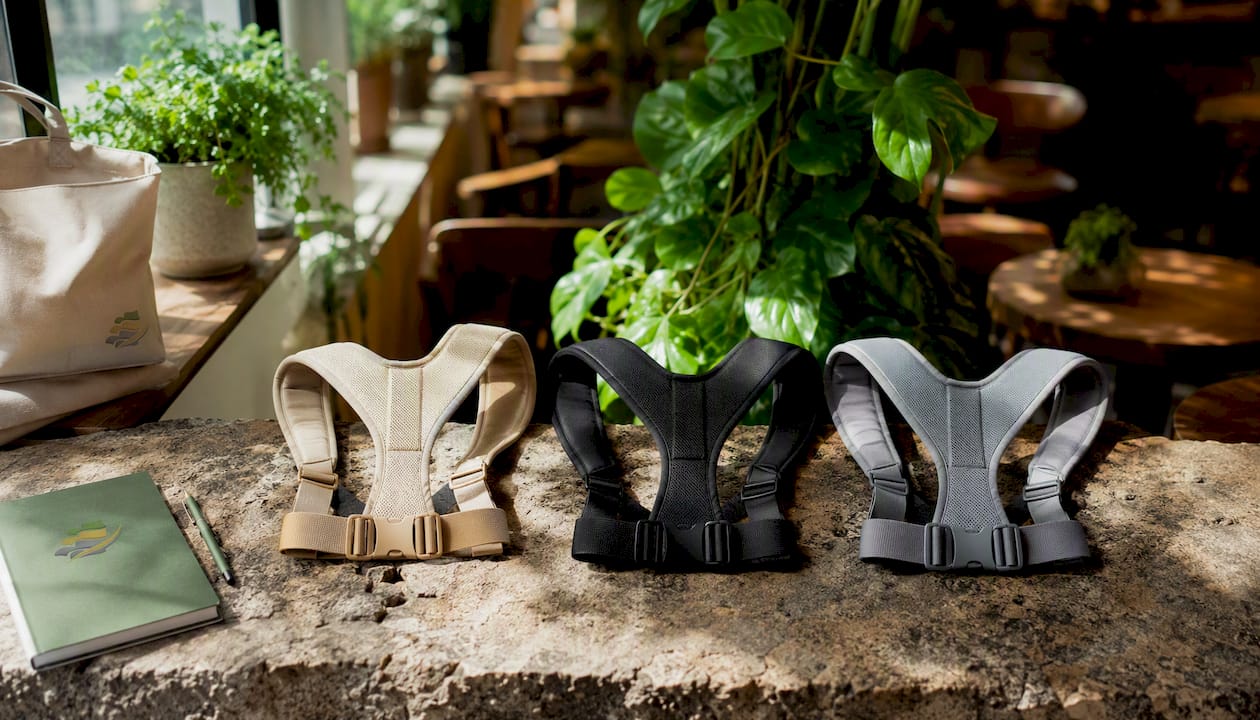
The recommended pick: Habit Posture Adjustable Posture Corrector
This is the go-to for remote workers who want an all-day posture reminder that doesn’t feel like a medical device. The adjustable straps let you dial in the fit across chest and shoulder widths, and the breathable construction keeps it comfortable through back-to-back Zoom calls. It’s designed to sit under clothing without creating visible bulk.
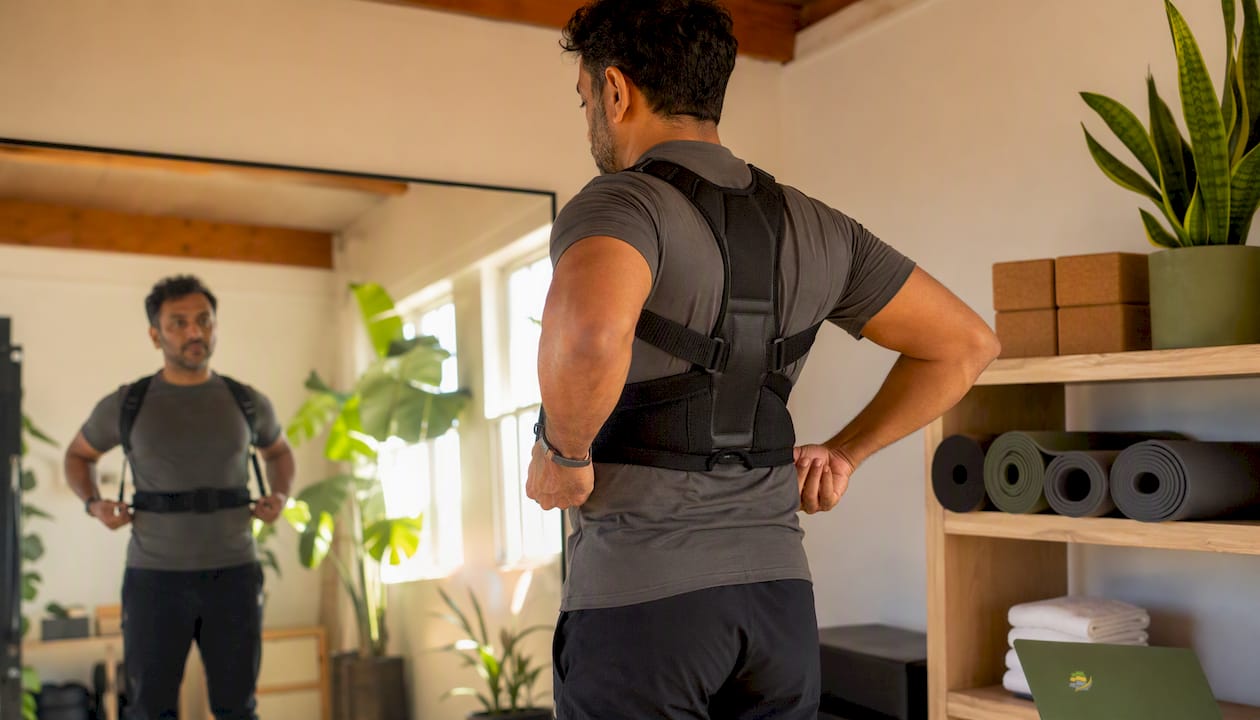
Wear schedule: Start with short sessions and gradually increase wear time. The goal is proprioceptive awareness, not rigid immobilization.
Sizing: Measure your chest circumference before ordering and follow the brand’s sizing guide. When in between sizes, size up for comfort.
Cleaning: Hand wash in cool water, air dry. Avoid machine washing to preserve Velcro longevity.
Return/warranty: Check the Habitposture product page for current return window details.
Soft shoulder-strap posture brace
Lightweight strap braces are the easiest entry point. They gently pull the shoulders back as a postural cue rather than forcing a fixed position. The main friction points are riding up during typing and armpit chafing on longer sessions. Look for soft-edge construction and adjustable height, not just strap tension.
- Pros: Low bulk, high wearability, fits under most shirts
- Cons: Can ride up; less effective for significant upper-back rounding
Full upper-back panel brace
Panel braces cover more of the mid- and upper-back, making them better suited for people with more pronounced forward rounding. The trade-off is visibility under thin shirts and reduced breathability. Posture devices split into soft shoulder/strap braces and fuller back-panel braces, and panel designs offer broader coverage at the cost of bulk.
- Pros: Better structural coverage, more stable for longer sessions
- Cons: Visible under clothing, warmer to wear
Wearable posture trainer (tech-reminder category)
Devices like the Upright Go S and Upright Go S Lite use adhesive sensors placed on the upper back to detect slouching and send a haptic vibration reminder. The Upright Go S Lite is the more accessible entry point; the full Upright Go S adds more detailed app analytics. Both require correct placement and consistent app use to deliver results. Wearable posture trainers with haptic reminders are genuinely discreet during video calls since there are no visible straps.
- Pros: Invisible under any clothing, app-guided training
- Cons: Adhesive placement learning curve, battery management required
ComfyBrace Adjustable Posture Corrector
The ComfyBrace targets mid and upper spine support for chest sizes of 30" to 43". It’s fully adjustable, fits under clothing, and uses durable stitching with soft, breathable materials. The brand recommends starting at 5–10 minutes per day and building toward 1–2 hours. It comes with a lifetime warranty, which is a meaningful differentiator at its price point.
Posture Medic
Posture Medic uses a resistance-strap design that doubles as a light exercise tool. It’s better suited for short active training sessions than all-day passive wear. If you want to build postural muscle strength alongside habit training, it’s worth considering as a complement to a standard corrector.
Forme Power Bra
The Forme Power Bra integrates posture support directly into a bra structure, making it one of the most discreet options available for women. It’s designed for extended wear and eliminates the visible strap issue entirely. The price point is higher than most strap braces, but the wearability trade-off is real.
Mueller Lumbar Support Back Brace, BAXMAX Back Support, BraceAbility Work Back Brace for Heavy Lifting
These three are primarily lumbar and lower-back devices. Mueller and BAXMAX suit general office sitting; BraceAbility is built for hybrid roles involving physical tasks. None of them replace an upper-back posture corrector. They address a different anatomical zone and are best used alongside, not instead of, an upper-back device.
SEROLA Sacroiliac Belt and Aspen Evergreen 637 LSO Back Brace
The SEROLA targets sacroiliac joint instability, a specific lower-back condition. The Aspen Evergreen 637 LSO is a rigid lumbar-sacral orthosis used in clinical or post-injury contexts. Back braces are categorized as flexible, semi-rigid, and rigid, and selecting the right type for serious conditions requires clinical input. Neither belongs in a standard remote-worker posture toolkit without a clinician’s recommendation.
Pro Tip: Braces that dig into the armpits during typing are almost always the wrong size or lack adjustable height. Check that the product adjusts height, not just strap tension, before buying.
How to choose the right upper-back brace for working from home
Start with your primary goal. That single decision narrows the field faster than any other factor.
Decision checklist (in order):
- Primary goal: Posture habit training (soft brace or tech reminder) vs. structural upper-back support (panel brace) vs. combined lumbar and upper support (belt plus corrector)
- Breathability: Will you wear this for 2+ hours? Mesh or breathable fabric is non-negotiable for extended desk sessions
- Adjustability: Does it adjust at the shoulder height, not just strap tension? This prevents riding up during typing
- Discreteness: Does your work involve video calls? Prioritize low-profile designs or tech-reminder devices
- Material and allergy check: Neoprene causes reactions in some people; look for hypoallergenic or cotton-blend options if your skin is sensitive
- Chair and clothing compatibility: A brace that bunches against a high-backed chair or shows through your shirt won’t get worn consistently
Red flags to avoid:
- Rigid immobilization devices marketed for mild slouching (overkill and potentially harmful for everyday use)
- Products with no size guidance or a single-size-fits-all claim
- No return window or warranty listed on the product page
Questions to ask before buying: What is the size range? What is the recommended daily wear time? Is there a return window if the fit is wrong? Can it be machine washed?
Wearing your brace safely: schedules, limits, and when to stop
A posture corrector is a proprioceptive reminder, not a medical fix. Braces can relieve symptoms but not fix underlying injuries, and chronic or severe pain warrants a clinician’s assessment before you rely on any consumer device.
Progressive wear schedule:
- Start with very short sessions. Build muscular awareness before extending wear time.
- Increase duration gradually over one to two weeks as comfort allows.
- Target 1–2 hours per session maximum for soft posture correctors during desk work.
- Remove the brace for movement breaks. Standing, stretching, and walking are part of the system.
- Never sleep in a posture corrector unless a clinician specifically advises it.
Stop use and see a clinician if you notice: increasing pain during or after wear, numbness or tingling in the arms or hands, skin breakdown or persistent redness, or any sensation of restricted breathing.
Over-tightening a brace can cause muscle dependence and weaken the supporting muscles the device is supposed to train. The brace should feel like a gentle reminder, not a corset.
Cleaning and maintenance: Hand wash soft braces in cool water and air dry flat. Check Velcro fasteners after each wash and remove lint to preserve grip. Avoid tumble drying, which degrades elastic and foam components.
Pro Tip: Pairing a posture corrector with workstation adjustments — monitor at eye level, lumbar support in your chair, movement reminders every 45 minutes — produces better long-term results than any brace used in isolation.
Other options worth knowing about
If the main shortlist doesn’t quite fit your situation, these categories are worth a look:
- Lightweight neoprene shoulder trainers: Cheaper entry-level option for mild rounding; good for first-time brace users who want to test the habit before investing more
- Full mid-back panel braces: Better coverage for people with significant thoracic rounding who need more structure than a strap trainer provides
- App-connected posture reminders (beyond Upright Go): Several newer devices use similar haptic technology; useful for remote workers on frequent video calls who need zero visible hardware
- Lumbar belts for lower-back S-curve support: Addresses a different spinal zone than upper-back correctors; pairs well rather than substitutes
- Posture correction alternatives: Non-brace options like ergonomic chairs, lumbar cushions, and standing desk converters that address posture at the workstation level
Key Takeaways
The Habit Posture Adjustable Posture Corrector is the strongest single choice for remote workers who need all-day upper-back support that stays comfortable, discreet, and wearable through a full screen day.
| Point | Details |
|---|---|
| Top pick for remote workers | Habit Posture Adjustable Posture Corrector offers adjustable fit and breathable materials for all-day desk use. |
| Comfort drives consistency | The most wearable brace wins; an uncomfortable device gets abandoned regardless of how supportive it is. |
| Build wear time gradually | Start with short sessions and increase to 1–2 hours; never overtighten or wear overnight without clinical guidance. |
| Pair with workstation changes | Monitor height, lumbar chair support, and movement breaks amplify brace benefits significantly. |
| Know when to stop | Increasing pain, numbness, or skin breakdown means stop use and consult a clinician before continuing. |
The honest case for habit-based posture support
Most people shopping for a posture brace are looking for a shortcut. That’s understandable. Eight hours of screen time does real damage, and the idea that a single device can undo it is appealing.
Here’s what actually works: the brace is the trigger, not the cure. The value of a well-fitted posture corrector isn’t that it holds you upright by force. It’s that it interrupts the unconscious slouch often enough that your body starts to remember what upright feels like. That’s the habit loop Habitposture is built around.
What most guides miss is that the devices most likely to produce lasting change are the ones people actually wear consistently, not the ones with the most rigid support structure. A discreet, comfortable corrector worn daily for two weeks will outperform a heavy-duty panel brace worn twice and abandoned. The remote work posture problem isn’t solved by more restriction. It’s solved by more awareness, repeated often enough to become automatic.
The other thing worth saying plainly: no brace fixes a workstation that’s set up wrong. If your monitor is below eye level and your chair has no lumbar support, a posture corrector is fighting an uphill battle every minute you wear it. Fix the environment first, then use the brace to reinforce the habit.
The Habitposture adjustable corrector is ready when you are
If you’ve spent any time reading this and nodding along, the Habit Posture Adjustable Posture Corrector is the practical next step. It’s built for exactly the situation you’re in: long screen days, a home setup that wasn’t designed for eight-hour shifts, and a body that’s been quietly compensating for months.
It adjusts to your chest and shoulder width, sits under your shirt without showing, and uses breathable materials that won’t make you dread putting it on. No medical-grade bulk. No complicated setup. Just a well-made corrector designed for desk professionals who need posture gear that works in real life.
Before you order: Measure your chest circumference and check the sizing guide on the product page. Review the return policy so you’re covered if the fit needs adjusting. Then get the Habit Posture corrector and start building the habit today.
Sources and further reading
- The 8 Best Posture Correctors of 2026 — Health.com: Testing methodology, comfort scoring, and material guidance; supports methodology and safety sections.
- Types of Back Braces Used for Lower Back Pain — Spine-Health: Clinical brace categories (flexible, semi-rigid, rigid) and over-tightening warnings; supports safety and wear guidance.
- The 9 Best Back Braces of 2026 — Yahoo Health: Expert-recommended roundup with clinical caution notes; supports methodology and safety sections.
- Wirecutter — Posture and Workstation Guidance: Haptic posture trainer coverage and workstation pairing insights; supports tech-reminder category and how-to-choose sections.
- Posture and Remote Work Productivity: 2026 Guide — Habitposture: Workstation pairing advice and productivity framing for brace users.
- Why Working from Home Hurts Your Back: 2026 Guide — Habitposture: Remote-work posture pitfalls that contextualize brace use.
- Habit Posture Adjustable Posture Corrector — product page: Sizing, adjustability, and construction details for the recommended pick.